Clinical leadership is important in the nursing profession as it ensures safe, efficient and effective care within complex and resource-constrained healthcare environment. In addition, clinical leadership offers a possibility to make the competence of nurses visible in healthcare environments as well as among public. For many professional nurses, nursing educators and nursing students, the clinical leadership remains unclear, and it is often misunderstood as formal leadership role rather than as a part of every professional nurse’s work. This article will explore the concept of clinical leadership as it has not been well defined and integrated in nursing education. Furthermore, the article describes the development of the clinical leadership competency framework in collaboration with key stakeholders such as professional nurses, nursing educators and nursing students.
 Photo by freepik.com
Clinical Leadership in Nursing Education project
Clinical leadership in Nursing Education project is a two-year (2024 – 2026) KA2 Partnership in higher education project funded by Erasmus +. The project coordinator is UCLL (Belgium) and the partners are Laurea University of Applied Sciences (Finland) and CESPU (Portugal). In every participating country, the nursing education is guided by the EU directives (2005/36/EY, update 2013/55/EU), which means that the nursing education has similar content and the education is offered in bachelor level. The concept of clinical leadership is not well known within nursing education in partner countries, although, the clinical leadership has been studied for decades in research context, and there are guidelines targeted to improve the clinical leadership among healthcare professionals (e.g. Clinical Leadership Framework).
Clinical leadership in Nursing Education project aims to improve the understanding and implementation of clinical leadership in nursing education in the partner organisations and across the Europe. First, the project aims to produce a conceptual framework for clinical leadership describing the competencies required in the profession according to the literature. Secondly, the project will develop a gap analysis to identify the current misalignments between the nursing education curriculums and the competencies identified in the clinical leadership framework. After the analysis, the materials used in the gap analysis will be made available, so that the same exercise can be carried out in other contexts. This enables them to develop their curricula to substantially include content related to clinical leadership.
Finally, the project aims to produce an open access library, which includes pedagogical material for nursing educators and anyone who is interested in the topic. The project’s overall goal is to strengthen the nursing profession. It aims to prepare nursing students who have clinical leadership competencies and who are not afraid to take a lead and bring their nursing expertise in the decision making. The project seeks to support students in advocating for better evidence-based care for patients.
The concept of clinical leadership
Clinical leadership in nursing can be understood as either a formal leadership role or an informal role that potentially any nurse working in the clinical field can take on (Enghiad, Venturato & Ewashen 2022). In research literature, clinical leadership is usually seen as characteristics or approach independent of formal role (Stanley & Stanley 2017; Guibert-Lacasa & Vázquez-Calatayud 2022; Iraizoz-Iraizoz et al. 2023) and this is how it is also understood in this article as well as in the project. However, when reading international literature, it is good to be aware that clinical leadership can refer to different things – even the qualifications for a specific job acquired in further education (Clavo-Hall, Bender & Harvath 2018).
The clinical leader focuses on patient care and improving its quality. They lead changes, motivate the team, promote patient safety, and set visions. Clinical leadership tasks also include strengthening cooperation and professionalism, solving problems in daily clinical practice, and advocating for the patient’s interests. In addition, the clinical leader identifies areas for development and influences the organization’s practices and processes at all organizational levels. (Mianda & Voce 2017; Enghiad, Venturato & Ewashen 2022; Guibert-Lacasa & Vázquez-Calatayud 2022.)
Clinical leadership can promote desired outcomes and quality of care, as well as improve team performance and job satisfaction among nurses (Guibert-Lacasa & Vázquez-Calatayud 2022). Moreover, clinical leadership could be a way to underline the competence and responsibilities of nurses to healthcare professionals and to the public.
Given these benefits, the need for clinical leadership development is evident. Clinical leadership development should not be postponed until the nurses enter the practice. Instead, competence development should be started already during nursing education. To support this goal, it is important that we identify the key competence areas that a clinical leader should have.
Competency framework development
The development of the competency framework began with conducting an integrated literature review. Literature was retrieved using systematic searches in three databases (CINAHL, ProQuest Central and PubMed) and the selection of the articles was made independently by two researchers. Altogether, 35 peer-reviewed scientific articles were selected for the review, the analysis of which made it possible to form the first version of the framework. To ensure that the framework was grounded in high-quality research articles, the quality of the selected studies was assessed. This step is essential, as the development of conceptual structures such as a framework should always be supported by the best available evidence (McMeekin et al. 2020).
The framework created in the literature review was first assessed by experts in clinical leadership in nursing. In each of the three project countries, the project team asked one expert to assess the relevance and clarity of the framework and to present any development proposals. Following the expert evaluation, workshops were organised in each project country to further assess the framework. Nursing students and educators as well as nurses from the clinical field were invited to participate in the workshops. A total of 83 voluntary persons participated in the workshops.
Feedback from experts and workshops was compiled and was used among the project team to critically assess the framework. The literature review gave it a solid foundation, so there was no need for major edits based on feedback. However, feedback helped significantly to clarify, for example, the designation of competence areas and competence descriptions. Finally, the competency framework (Figure 1) consists of six domains which are ethics, professional nursing, innovation and change, influencing and advocacy, team leadership and communication and collaboration.
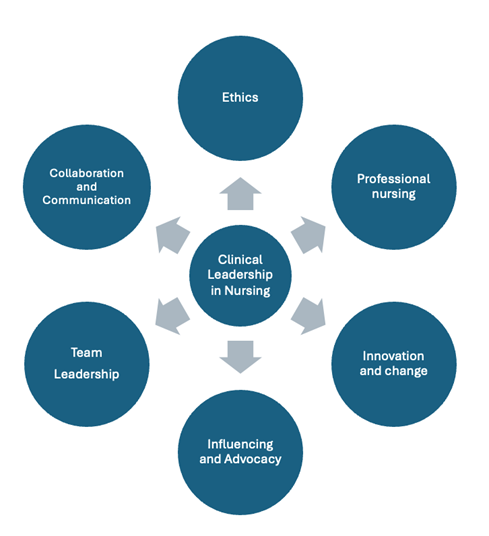 Figure 1. Clinical Leadership in Nursing profession – competency framework (Figure: Niina Glerean/Clinical Leadership in Nursing Education project)
The framework’s connection to the next steps in the project
The competency framework will be applied concretely in the project phase aimed at identifying discrepancies between the concepts of clinical leadership and nursing curricula. In addition, it will be made freely available for consultation and use by all interested parties, thereby fulfilling other indicators of the project.
To assess the difference between the theoretical concepts of clinical leadership and its approach within nursing curricula, workshops will be conducted with lecturers, professionals, and final-year students. In addition to open-ended questions typically used in a SWOT analysis, the framework will be presented, and participants will be asked to identify whether the different domains, and competence descriptions in the competency framework are in any way integrated into the curricula, and to what extent. This exercise allows a comparison between the framework and the curricular approach to clinical leadership, providing a more structured, in-depth, and rigorous form of analysis.
At the end, data will be collected to determine how different nursing curricula address clinical leadership in both theoretical and practical contexts. Furthermore, it will be possible to assess whether the framework is easily understood, interpreted, and applicable for such curricular analyses. Participants will also be invited to provide feedback on the competency framework, contributing to its refinement and enhancing its clarity and usability. Ultimately, a well-developed framework, along with guidelines for conducting SWOT analyses in similar contexts, will be made available to all interested parties, facilitating the broader integration of clinical leadership development in nursing curricula beyond the borders of these project partners.
The competency framework will guide the development of pedagogical materials in the Clinical Leadership Library and will be made available as an open-access resource for educators, students, and practitioners on the project website. It will inform the creation of theoretical content and recommendations for teaching methods. Moreover, the competency framework will serve as a reference point in workshops with simulation of trainers, communication trainers, and internship supervisors. This will help align simulation cases, communication exercises, and internship objectives with the competencies outlined in the framework. The competency framework will also be integrated into events for educators, practitioners, and students, where it will clarify the concept of clinical leadership and illustrate its relevance for educational practice. These events aim to build shared understanding and foster dialogue between academic and clinical settings. Finally, the framework will feature in dissemination activities including blogs, social media updates and conference presentations reinforcing its role as a cornerstone of the project’s outputs and extending its reach beyond the partner institutions.
Future development of the competency framework
In the future, the competency framework could be utilised for example in education and research. The framework visualizes the competencies required for clinical leadership in nursing. It provides nurse educators with the opportunity to use it in curriculum planning, as well as a basis for the development of courses or academic assignments. The potential of the competency framework to guide, to some extent, the construction of nursing curricula is not limited to the curriculum. The competency framework also allows individual courses or curricular units to be reconsidered. This allows incorporating its concepts into theoretical content, practical implementation, and pedagogical dynamics in a more concrete manner. In the research context, the framework can be used to further investigate the topic and to stimulate additional research. This allows the translation of research evidence into health policies or management strategies that support the development of these competencies in practice. As a result, health outcomes can be improved at the population level, while the visibility of nursing competence is strengthened and the public image of the nursing profession is enhanced. In addition, descriptive interview study has been already started by Laurea University of Applied Sciences master students alongside the project to further investigate nurses’ perception of clinical leadership in different clinical settings. This study will produce new knowledge on the clinical leadership in Finnish context, and it will offer possibilities to use the information in developing the pedagogical material for the project.
References:
- Clavo-Hall, J. A., Bender, M., & Harvath, T. A. 2018. Roles enacted by Clinical Nurse Leaders across the healthcare spectrum: A systematic literature review. Journal of Professional Nursing 34(4), 259–268.
- Directive 2005/36/EY. Accessed 3.12 2025.
- Enghiad, P., Venturato, L. & Ewashen C. 2022. Exploring clinical leadership in long-term care: An integrative literature review. Journal of Nursing Management 30(1), 90-103.
- Guibert-Lacasa, C., & Vázquez-Calatayud, M. 2022. Nurses’ clinical leadership in the hospital setting: A systematic review. Journal of Nursing Management 30(4) 913–925.
- Iraizoz-Iraizoz, A., García-García, R., Navarrete-Muro, A., Blasco-Zafra A., Rodríguez-Beperet, A. & Vázquez-Calatayud, M. 2023. Nurses’ clinical leadership in the intensive care unit: A scoping review. Intensive and Critical Care Nursing, 75,103368.
- McMeekin, N., Wu, O., Germeni, E. & Briggs, A. 2020. How methodological frameworks are being developed: evidence from a scoping review. BMC Medical Research Methodology 20(1), 173.
- Stanley, D. & Stanley, K. 2018. Clinical leadership and nursing explored: A literature search. Journal of Clinical Nursing 27(9-10),1730-1743.
