When I travelled to Gothenburg in early February to attend Navy Tech & Seabed Defence 2026 Conference, I expected to hear mainly about new technologies and emerging threats. What I did not fully anticipate was how strongly the conversations would revolve around urgency, and how openly senior defence actors would acknowledge that Europe must catch up quickly on its defence, and time is not on our side. Over three days (3–5 February 2026), the key message emerging from several conference sessions was that Critical Underwater Infrastructure (CUI) is no longer just a technical niche or a maritime side issue. It is now central to European security. And the shift is happening fast. In the following article I give my reflections from the conference, shaped both by the atmosphere in the room and by the formal presentations.
 Picture: Seabed Defence Conference 2026, Johanna Karvonen
From Protecting Cables to Rethinking Maritime Security
The Conference started with a keynote session by Major General Tom Bateman, where he described the Standing Joint Force Headquarters, a rapidly deployable component of the British Armed Forces, and what their role is in NATO and Allied Operations. Listening to his presentation I was struck by how candid he was about the limits of national approaches. No country, he emphasised, can do this alone. No single navy can “guard the seabed itself.” His description of the Joint Expeditionary Force as agile and decision-oriented resonated with me. It wasn’t about building parallel structures to NATO; it was about being fast enough to plug into what already exists. His comment: “Tell me what you’ve got, and I will work it into the solution” captured that mindset perfectly. It felt less like rigid doctrine and more like adaptive problem-solving. That spirit carried through the entire conference: CUI protection is no longer about isolated assets. It is about building a comprehensive systemic maritime security architecture.
The Ministerial Forum with Sweden’s Defence Minister Pål Jonson and Denmark’s Defence Minister Troels Lund Poulsen was one of the more straightforward and interesting discussions of the conference. Both ministers spoke about the need to move faster, particularly when it comes to procuring unmanned systems, strengthening regional cooperation, and making better use of dual-use technologies. The tone of the discussion felt unusually direct for a ministerial panel. Poulsen noted that Europe is still not scaling up quickly enough and argued that bureaucracy is slowing things down more than it should. When he suggested that governments need to “aggressively attack bureaucracy,” it clearly resonated with many in the room. Listening to the discussion, I was reminded how much timelines matter in this field. Procurement processes, certification procedures, and coordination between institutions can take years. Several speakers hinted that if these processes remain slow, they may become part of the problem rather than simply an administrative reality.
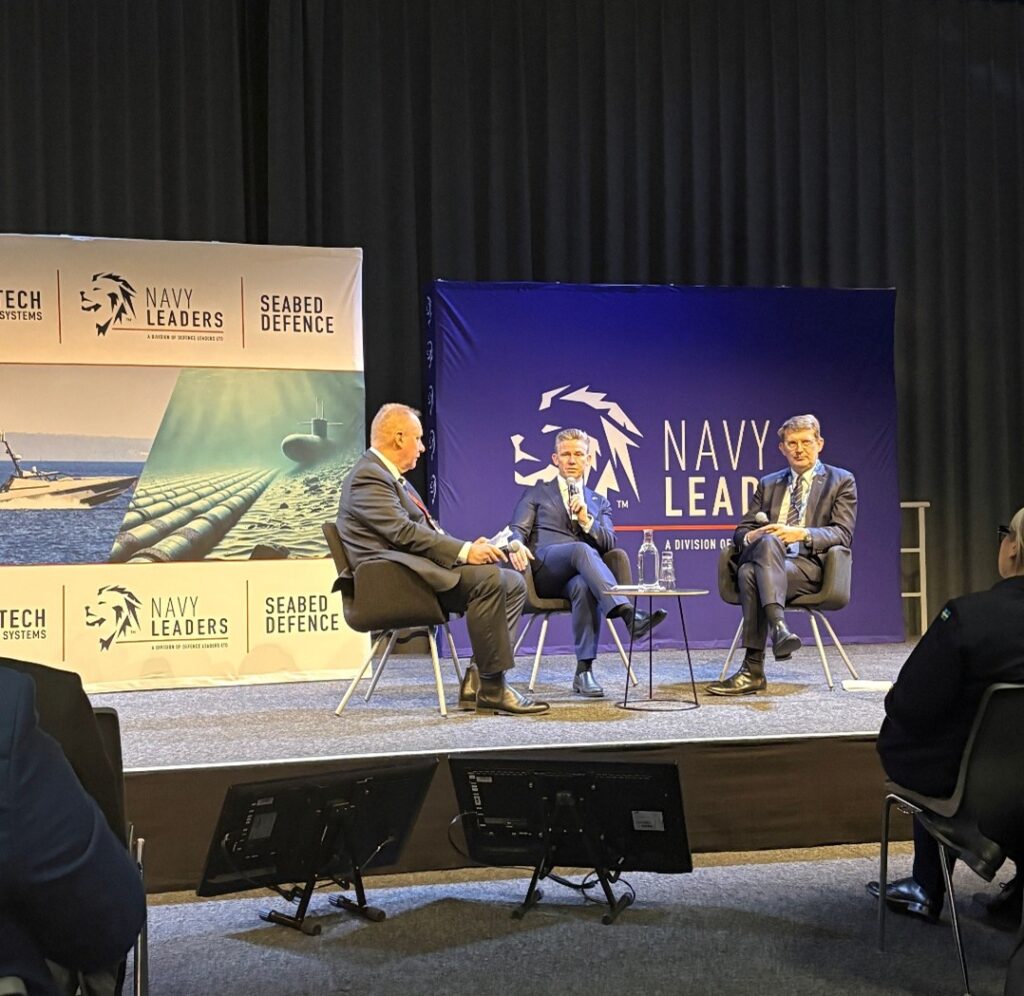 Picture: The Ministerial Forum with Sweden’s Defence Minister Pål Jonson and Denmark’s Defence Minister Troels Lund Poulsen at the Seabed Defence Conference 2026, Johanna Karvonen
The Baltic as a Real-World Testbed
If the ministerial discussion was strategic, the Baltic-focused sessions were operational and grounded. Captain Tadas Jablonskis of the Lithuanian Navy delivered what I found to be one of the most concrete presentations of the conference. His phrase “You cannot protect the highway with one police car” felt particularly important, stressing that the whole Baltic region needs to cooperate in order to protect the underwater infrastructure. He also described the growing role of NATO’s CUI Coordination Cell and referred to the expanding ecosystem around it, including the NATO Maritime Centre for the Security of Critical Underwater Infrastructure and NATO Task Force X, which both are NATO initiatives aimed at strengthening the protection of critical underwater infrastructure, with the former coordinating monitoring and resilience efforts and the latter integrating unmanned systems and new technologies to improve maritime surveillance and situational awareness. What became clear is that the Baltic Sea has turned into a live laboratory. New operational concepts are being tested in real time. Unmanned systems are no longer experimental add-ons; they are becoming integral to presence, detection, and response.
Jablonskis also raised something I had heard less explicitly elsewhere: data security. Monitoring infrastructure is one thing; ensuring that collected data is encrypted, shared appropriately, and legally actionable is another. Without trusted data-sharing, situational awareness collapses. There was also repeated reference to closer coordination among NATO’s senior legal advisors. Maritime law, especially in grey-zone scenarios, is not abstract theory anymore. How Europe interprets and applies it in the Baltic is being watched closely beyond the region.
Another moment that left an impression on me was the session on NATO’s Baltic Sentry initiative, presented by Commodore Sean Williams from NATO MARCOM. Launched in early 2025, Baltic Sentry has shifted the operational picture in the Baltic Sea. Increased presence has improved awareness, but it has also revealed more suspicious activity. That paradox was openly acknowledged: when you look more carefully, you see more. What I found particularly significant was how seamlessly unmanned systems are now embedded in these operations. This is not futuristic language anymore. It is standard operational practice. And yet, the repeated emphasis was not on hardware, but on cohesion. The ability to act together across nations, commands, and domains remains NATO’s key advantage.
The involvement of Industry and legal boundaries
The panel on how we can utilise the innovations in the private sector to best protect CUI was refreshingly pragmatic. Representatives from cable operators, marine technology centres, repair agreements, and the European Commission spoke less about futuristic breakthroughs and more about testing environments, shared exercises, and trust-building. One example discussed was the Swedish Navy’s experimental innovation environment “The Max” in Karlskrona, a space designed to shorten the gap between prototype and operational use. What struck me here was the realisation that many of the technologies we need already exist. The bottleneck is not invention. It is integration, certification, and joint experimentation.
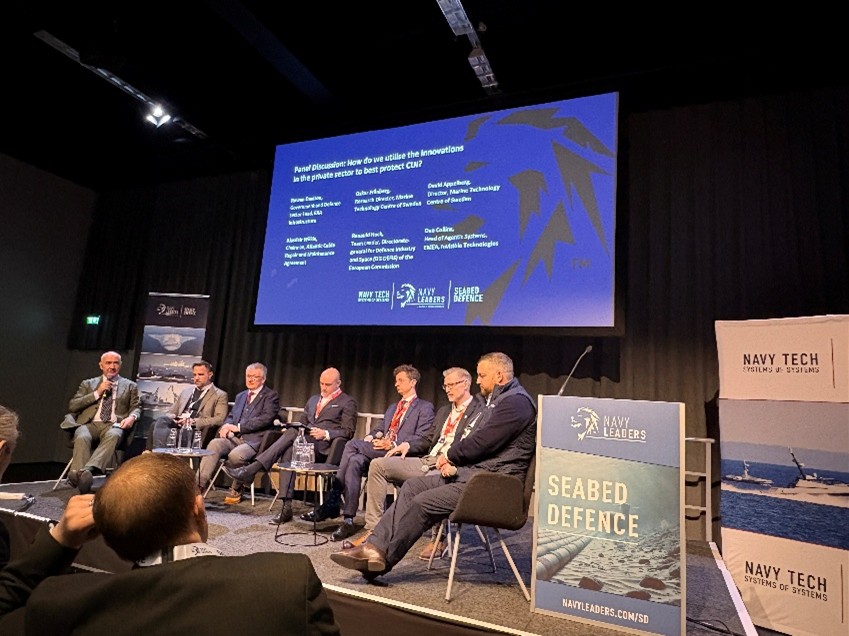 Picture: Panel Discussion on How do we utilise the innovations in the private sector to best protect CUI? At Seabed Defence 2026, Johanna Karvonen
Across multiple sessions, I sensed an underlying tension: how to act decisively in grey-zone situations without overstepping legal boundaries. NATO’s legal experts are working more closely together than before to interpret what maritime law allows in peacetime. The Baltic has effectively become a proving ground for these interpretations. The implications extend far beyond Northern Europe. This legal dimension may be less visible than unmanned drones or naval patrols, but it is equally decisive. Without clarity, response options remain constrained.
Conclusion – From Protection to Resilience
As I left Gothenburg, I realised that the vocabulary itself is changing. We are moving from “protecting infrastructure” to “ensuring resilience.” Protection suggests guarding assets. Resilience assumes that incidents will happen, and focuses on absorption, recovery, redundancy, and continuity. This conceptual shift is increasingly also reflected in European policy. The EU’s Preparedness Union Strategy (European Commission & High Representative, 2025a), launched in March 2025, calls for a whole-of-government and whole-of-society approach to crisis preparedness, one that explicitly encompasses critical infrastructure, cyber threats, and hybrid attacks. Rather than treating security threats as isolated events, the strategy promotes an integrated, all-hazards framework that resonates strongly with the lessons drawn at the Gothenburg conference.
Three key take aways from the conference:
- Persistent situational awareness is indispensable. You cannot defend what you cannot continuously observe. NATO’s Baltic Sentry initiative, launched in January 2025, operationalised this principle by deploying frigates, maritime patrol aircraft, naval drones, and advanced surveillance technology specifically to improve monitoring of critical undersea infrastructure in the Baltic Sea (NATO, 2025). The initiative directly addresses the “see more when you look more” paradox acknowledged at the conference: enhanced presence yields enhanced awareness.
- Speed matters as much as capability. Bureaucracy is no longer neutral; it shapes security outcomes. The EU’s Cable Security Toolbox (European Commission, 2026), published in February 2026 as part of the broader EU Action Plan on Cable Security, illustrates both the urgency and the institutional complexity involved. The Toolbox outlines six strategic and four technical measures to address identified risk scenarios including coordinated physical sabotage, cyber intrusions, and supply chain disruption. At the same time, its development, spanning a Recommendation in 2024, an Action Plan in February 2025, an EU-wide risk assessment in October 2025, and the final Toolbox in early 2026, demonstrates exactly how long policy cycles can take, even when the threat is acknowledged as urgent.
- CUI protection cannot purely be done by the military. It requires legal clarity, trusted data-sharing, industry engagement, and multinational coordination. This finding is reinforced by the EU Action Plan on Cable Security (European Commission & High Representative, 2025b), which frames cable security across the full resilience cycle – prevention, detection, response, recovery, and deterrence – and explicitly requires close complementarity with NATO activities. The EU Action Plan also highlights that submarine cables carry 99% of intercontinental internet traffic, underlining how deeply civilian and military security interests are intertwined in this domain.
The seabed remains invisible to most of us. Yet everything above it such as financial systems, energy supply, and digital connectivity depends on it. What I felt most strongly at this conference was not alarmism, but momentum. Structures are being built. Expert groups are forming. Operational concepts are being tested. The question is no longer whether CUI protection matters. The question is whether Europe can move fast enough to stay ahead of the risks.
This is precisely where applied research has a role to play alongside policy and defence. The Laurea Coordinated VIGIMARE project (Vigilant Maritime Surveillance of Critical Submarine Infrastructure, funded by Horizon Europe) directly addresses many of the gaps discussed at the conference (VIGIMARE, 2024). Running from September 2024 to August 2027, the project is developing an AI-powered situational awareness system, the Virtual Collaborative Room (VCR), which enables critical infrastructure owners, border and maritime authorities, and other stakeholders to share information and respond more effectively to threats against submarine telecommunications cables, power cables, and gas pipelines. The VIGIMARE system aims to provide early warning of suspicious maritime behaviour around Europe’s most critical subsea assets.
VIGIMARE’s approach aligns closely with the three takeaways above. On situational awareness, the project’s AI system is designed to detect anomalous vessel behaviour, such as a vessel slowing unexpectedly near cable routes, going “dark” by switching off its AIS transponder, or showing discrepancies between satellite imagery and broadcast position data, and alert responsible authorities in near-real time. On speed, by placing AI-driven tools directly in the hands of infrastructure operators rather than waiting for military or government response chains, the project shortens the gap between detection and action. On the civil-military information dimension, VIGIMARE’s VCR is specifically designed to enable trusted information sharing across organisational and national boundaries, addressing one of the key legal and operational bottlenecks identified at the conference. The project also directly supports EU member states in implementing the CER Directive on critical entities resilience and the NIS2 Directive on cybersecurity, further embedding CUI protection into the broader EU governance architecture that the Cable Security Toolbox and Preparedness Union Strategy are seeking to strengthen (Karvonen, 2025).
The conference in Gothenburg and the broader policy landscape both point in the same direction: protecting Europe’s critical underwater infrastructure is a shared endeavour that requires persistent awareness, fast decision-making, trusted information sharing, and close collaboration between civilian operators, public authorities, and military actors. Research projects such as VIGIMARE contribute to this ecosystem by developing the practical tools and frameworks that policy commitments alone cannot deliver.
References
The language editing and structure for this text has been improved using Copilot.
