Bett UK 2026, the education technology fair, was held at exhibition center ExCeL London from 21 to 23 January 2026, bringing together teachers, school leaders, researchers, and EdTech companies from around the world. The event’s theme, “Learning without limits,” showed how technology can be used to help every learner. One of the biggest topics at Bett this year was artificial intelligence (AI), not just as a new technology, but as a practical tool that can be used in everyday work. The trip to Bett UK 2026 was part of the Saavuta Äly project, which supports the responsible adoption and meaningful use of AI in third sector organizations. This article summarizes some of the most relevant AI-related topics presented at the fair.

More than 35,000 professionals in education, research, and technology from around the world visited the bustling Bett fair in London in January 2026. Picture by Outi Loikkanen.
AI in practice: use cases for work
Originally started in 1985, the letters Bett originate from British Educational Technology Show (Bett 2026). In 2026 many sessions focused on how artificial intelligence can be used to support daily tasks in both education and professional work. One clear theme was that AI helps by taking over repetitive tasks, so people, whether teachers or business professionals, can focus on higher-value work such as creativity, problem solving, and emphatic human interaction (Taylor 2026).
One of the sessions was “AI for business services and operational efficiency”, presented by Chris Loveday, Vice Principal at Barton Peveril Sixth Form College, where he leads the college’s AI transformation across operations and has implemented bespoke AI tools to improve enrolment, compliance, timetabling and analytics. He described how AI can automate repetitive administrative tasks, optimize workflows, and give staff more time for value-adding activities such as strategy development, teamwork, and stakeholder engagement. This session showed that by using AI tools to handle routine work like data entry, HR processes, finance admin and communications, organizations can free up employees to focus on higher-level work that requires human judgement and creativity. This is a key driver of productivity in both educational institutions and the broader workplace. AI-driven workflow automation can reduce errors, accelerate routine processes and support real-time decision-making by analyzing large data sets, enabling teams to spend their time on innovation and collaboration rather than repetitive manual tasks.
Similarly, the session “The innovation roadmap: Is your school on the path?”, held by Sarbani Bose and Victoria Merrick, reframed technology adoption as part of a broader strategic intelligence framework. Sarbani Bose, CEO and Founder of Deesha.ai, has long experience in data and analytics and leads the development of an AI-powered insights platform that helps organizations turn complex data into actionable decisions. Victoria Merrick, CEO and Founder of Merrick-Ed Limited, specializes in curriculum, assessment and data coherence, supporting education leaders to make informed, equity-focused decisions in the UK and internationally. Rather than simply acquiring tools, the session encouraged organizations to view AI and data analytics as foundational systems that sense, reason and adapt to students’ needs. These capabilities also help teams forecast trends, personalize services, and align strategic objectives with real-time insights across diverse work contexts.
Although many sessions focused on high-level strategic advantages of AI, there were also hands-on sessions like “Innovation in the classroom: AI lesson planning to support every learner” by Julie Carson and Mark Anderson. Julie Carson, Director of Education at Woodland Academy Trust, and Mark Anderson, an experienced educator and consultant, shared practical tools such as using mega prompts for systematic lesson planning and provided a concrete example of how organizations can embed AI into strategy and daily practice.
Another strong message at Bett was the importance of ethical and thoughtful AI use. Educators and technology leaders emphasized that AI should augment human expertise, not replace it (Fry & Rajan 2026). This idea applies beyond education: in every workplace, from health care to finance, employees work alongside AI systems to enhance productivity without giving up responsibility or critical judgement. Across sectors, people are encouraged to practice human-in-the-loop AI adoption, where humans guide, interpret and oversee AI output rather than treat them as final answers.
AI for inclusion and future work skills
Bett UK 2026 also highlighted AI’s potential to support inclusion and future workforce skills. Presenters discussed how AI can personalize learning experiences for students with diverse needs and help learners build skills that will be valuable in tomorrow’s jobs.
For instance, research on human-AI cooperation suggests that workers who develop both technical and conceptual skills will be better positioned to succeed in the modern workplace, where AI tools handle routine data processing and professionals focus on interpretation, innovation and leadership. When humans and AI work together, people need to develop meta-skills such as critical thinking, ethical judgement, and interpretive reasoning, that help them collaborate with AI rather than compete against it. These skills are increasingly important in roles where professionals integrate insights from AI systems with contextual understanding to make sound decisions. (Fry & Rajan 2026.)
To promote inclusion and accessibility, AI can tailor experiences to individual needs — for example by offering adaptive content to learners or generating customized insights for professionals facing specific challenges. This reflects broader research on inclusive technology design, which shows that AI can help close gaps, support diverse populations, and extend services to traditionally underserved groups. (McInereys & Oliver 2026.)
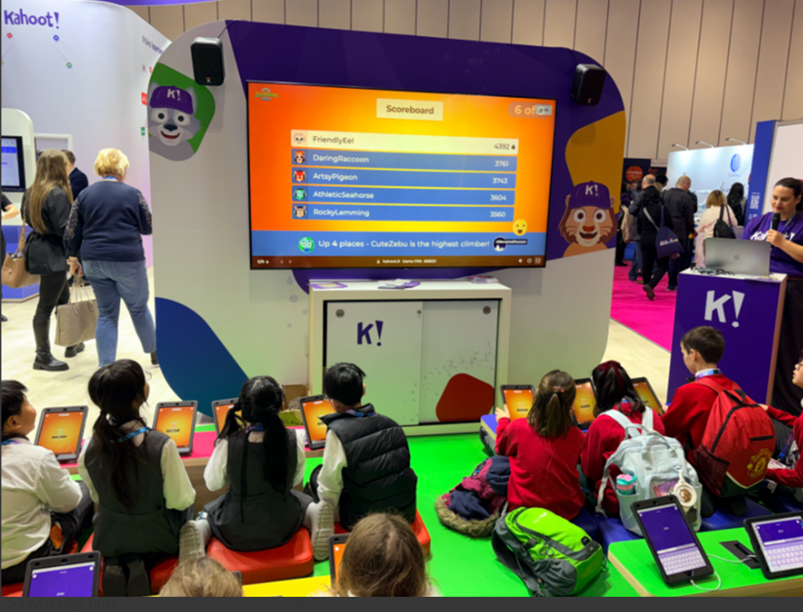
Many digital educational tools were presented at the fair, here students are playing Kahoot. Picture by Outi Loikkanen.
Conclusion: Why Bett UK 2026 matters beyond education
Bett UK 2026 demonstrated that artificial intelligence is not only transforming education but also reshaping how organizations operate, innovate, and address complex challenges. The tools showcased at the event have practical uses in planning, communication, workflow management, and strategic decision-making that extend far beyond the classroom. Equally important were the discussions around ethical AI use, human-centered design, and inclusive practice — themes that offer valuable guidance for any organization beginning or deepening its adoption of emerging technologies.
Attending Bett UK 2026 gave participants a unique opportunity to connect practical examples, research insights, and expert perspectives that are directly relevant to both educational and non-educational work environments. These insights are especially useful for organizations involved in initiatives aimed at building AI readiness, promoting responsible use, and enhancing operational capacity. By bringing together a diverse community of practitioners, the event highlighted that the challenges and opportunities posed by AI are shared across sectors.
One clear message from Bett was that AI is already part of today’s reality, not just a vision for the future. For educators, this means considering how AI can be used in ways that support meaningful learning, enhance professional practice, and align with core values such as fairness and ethical responsibility. AI can take over routine, time-consuming tasks, giving teachers — and professionals in other fields — more space to focus on meaningful human interaction, strategic thinking, and creative problem solving. At the same time, it can enable more personalized, engaging experiences for learners and users alike.
For teachers and other professionals alike, the key takeaways are clear: use AI with clear goals that serve real needs, support the development of critical thinking and ethical awareness, and choose tools that reinforce inclusion and equity. When organizations approach AI as a thoughtful partner rather than a quick fix, they can better prepare their communities for the future, helping learners and workers alike to become confident and responsible users of technology.
The SaavutaÄly – AI Competence Supporting Civil Society in Transition project aims to strengthen AI skills and the ability to apply artificial intelligence in developing work and organizations within the third sector. It targets NGO employees and volunteers, helping them respond to changing competence needs in working life while supporting adaptability, innovation, and sustainable careers.
The project also promotes experimental use of AI to find new solutions for everyday work and improve accessibility. Funded by the Häme ELY Centre through the European Social Fund (ESF), the project runs from November 2024 to October 2026 in the Uusimaa region and is implemented by Laurea and Humak Universities of Applied Sciences.

The language editing for this text has been improved using Copilot.
References
- Bett 2026. Bett UK: Leading EdTech Event | 20-22 Jan 2027, ExCeL London. Website, visited 3.2.2026.
- Bose, S. & Merrick, V. 2026. The innovation roadmap: Is your school on the path? Presentation at Bett UK 23.1.2026. London.
- Carson, J. & Anderson, M. 2026. Innovation in the classroom: AI lesson planning to support every learner. Presentation at Bett UK 22.1.2026. London.
- Fry, H. & Rajan, A. AI and the future of learning: Hannah Fry and Amol Rajan in conversation. Presentation at Bett UK 21.1.2026. London.
- Loveday, C. 2026. AI for business services and operational efficiency. Presentation at Bett UK 21.1.2026. London.
- McInerney, L. & Oliver, M. 2026. Reflections on Ofsted’s new era: Transparency, inclusion, and accountability in practice. Presentation at Bett UK 22.1.2026. London.
- Taylor, D. 2026. The Changing Role of a Teacher in the Age of AI. Presentation at Bett UK 21.1.2026. London.
