All international cooperation is in a way or another communication between individuals, has the late Queen Elizabeth II has said in one biographical documentary. The truth lies indeed in those words of the monarch who oversaw her country`s important international relations for decades. Nations, institutions and organizations don`t internationalize unless the individuals within them communicate across borders.
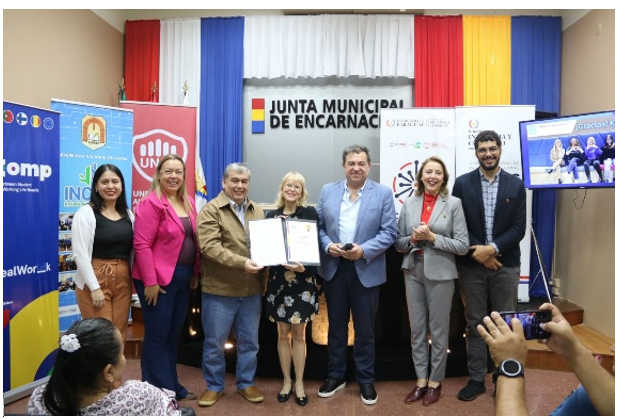
Strategic and human partnerships in action. Photo by E. Wainio.
After defining internationalization of higher education, this paper narrates Laurea`s cooperation with two Paraguayan higher education institutes (HEI) through my experiences and reflections. It demonstrates how intertwined and mutually reinforcing human and strategic partnerships are in making strategies and visions real. Furthermore, it illustrates some enriching effects of international partnerships.
Higher education internationalization
In the context of higher education institutions, Knight (2004, 11) defines internationalization as “the process of integrating the international dimension into the teaching, research and service functions.” It implies connecting with new and different perspectives, enhancing the quality of education and research for staff and students, and making meaningful contribution to society, with better understanding of the surrounding world (Brandenburg, de Wir, Jones & Leask 2019).
Regarding Finland, internationalization of higher education must be seen as an integral part of of HEIs to make Finland an international actor larger than its size. As higher education is not a separate island from society, international thinking, global responsibility and tolerance must be promoted in all sectors of society (Kokko et al. 2020, 11). As the former Minister of Education, Sanni Grahn-Laasonen has stated, the graduates from Finnish HEIs must have competencies and motivation to act in international and culturally diverse environments, and understand diversity, global challenges and the principals of sustainable society. Thus, mobilities and internationalization at home must be incorporated into students´ studies and employees´ work. (Ministry of Education and Culture 2017, 3.)
HEIs willing to embrace seriously international collaboration, should ensure that internationalization is properly embedded into their mission (Pedró & Galán 2022, 6). To make the strategies, missions and visions real, human-to-human encounters and cooperation between HEIs are needed. In its strategy 2035, Laurea University of Applied Sciences has stated in its vision to be an Internationally competitive higher education institution with working life relevance (Laurea 2025). The vision invites all Laurea staff members to make the strategy alive in practice. There are countless opportunities to do so as the meaning of internationalization may vary according to personnel group and individual interests. As Knight (2013, 84-87) explains, it can mean taking an international, intercultural, and/or global dimension in the teaching-learning process, collaborative online learning, internships and curriculum as well as in creating education hubs, strategic partnerships and knowledge alliances. To some, it may mean international development projects or commercial cross border education.
Laurea – Paraguay collaboration
In south-eastern Paraguay, by the Paraná river, Laurea has two partner universities in the city of Encarnación. The city with around 100 000 inhabitants is also known as Itapúa, in Guaraní which is the country´s other official language besides Spanish (Britannica 2025.) The partner universities present both public and private higher education institutions: Universidad de Itapúa (UNI) is public whereas Universidad Autónoma de Encarnación (UNAE) is a privately founded and run. Both universities are multidisciplinary, offering a great variety of degrees in different fields: architecture, veterinaries, business, Guaraní culture, fashion, law, et cetera.
The strategic partnership with UNAE and UNI began in Erasmus+ Capacity Building project HEIComp -Bridging the Gap Between Students` Competences and Working Life Needs, which was run 2023-2025. Human partnerships played a key role in forming the project consortium: a Romanian colleague introduced me a Brazilian colleague who had a project idea in mind. By utilizing our contacts, the consortium of HEIs in Finland, Romania, Portugal, Paraguay and Brazil was established, and grant application written. In addition to coordination, the key task of the five-member team of Laurea was coaching Latin American teachers to learn and apply Learning by Developing (LbD) pedagogical model. Each Laurea team member coached one group in a Latin American HEI, which gave a good chance to create personal partnerships with the foreign colleagues. To all, it was great to see how Laurea`s pedagogical method LbD could be applied in international context, not by pasting but thoughtfully suited to the local strategies and policies as well as academic, cultural and societal realities.
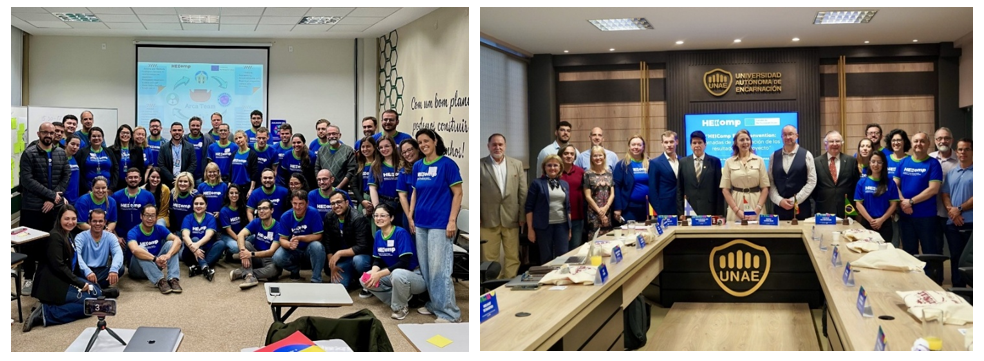
HEIComp project onsite training in Varginja, Brazil (HEIComp) and closing event in Encarnación, Paraguay. Photo by E. Wainio.
The Paraguayan teachers` commitment to the transformative modernizing of higher education was impressive. Common in Paraguay, the most of them -like their students- work outside the university during daytime, spending then evenings and even weekends in their educational work. Still, they energetically put a lot of effort in introducing the LbD-based Working Life Connected (WLC) learning model internally and externally to the stakeholders.
Invited and funded by UNAE and UNI, I did a trip to Encarnación to advance the transformation with my expertise in WLC. During my trip, I had a great opportunity to communicate with various stakeholders from students and university administrators to entrepreneurs and municipality decisionmakers. Laurea`s way of integrating real development projects into studies aroused enormous interest yet also partly doubts. By HEIComp project closing conference in Encarnación in November 2025, with many successful WLC projects conducted with local organizations, the doubts had mostly turned into confidence of the model´s functionality. Laurea`s expertise in work life -connected pedagogy, was praised even by the representative of the Paraguayan Ministry Education.
As a spinoff of the HEIComp, with deepened human partnerships, a Collaborative Online International Learning (COIL) was planned and implemented with UNAE in 2025. It was based on complementary study unit Leading International Project Team, taught by me. Again, the personal networks were helpful in engaging beneficiaries like local JCI´s, Small Business Development Center and a globally operating culture consultancy company to the COIL. Actually, the COIL become an Erasmus+ Global Mobility KA171 project with a separate funding which enables incoming staff and student mobilities to Finland, and outgoing staff mobilities to Paraguay in 2025 and 2026. During the COIL´s online and onsite studies, Laurea and UNAE students have authentic intercultural encounters which enhance their international competencies and enlarge their networks abroad. In the feedback from the implementation in 2025, students reported improved intercultural communication, empathetic approach and understanding of various cultural traditions and practices (Wainio & Escurra 2025, 9-10). For the outcome of the intercultural teamwork, the student teams joint their forces to create a A Guide for Working Internationally which the beneficiaries welcomed positively.
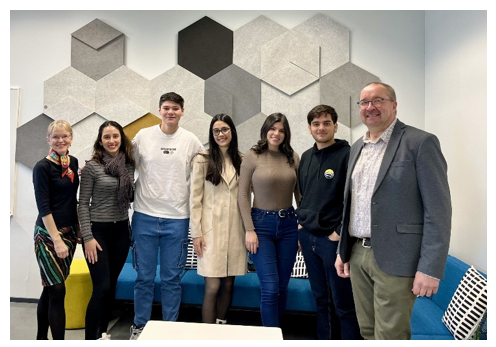
Paraguayan COIL/Global Mobility participants at Laurea. Photo by E. Wainio.
Preliminary ideas of a COIL have been discussed also with UNI, which has already sent two teachers on a mobility to Laurea.
Learnings and reflections
Cooperation between Laurea and Paraguayan colleagues has offered unique perspectives to higher education internationalization in practice. It has provided a more comprehensive understanding of the real Paraguayan lifeworld which impacts also their academic life. Internationalization has been realized in reciprocal learning process in which expertise is created in dialogue and responsibilities shared to reach the joint aims.
People and emotion orientation, personal relations and interweaving social/professional are characteristic in multi-active cultures, like Paraguay, where pprofessional discussions continue in informal settings, and social situations are an integral part of building collaboration (Lewis 2000, 36-49). As a continuum, many of my collegial partnerships have deepened into friendship. When interaction between individuals is authentic and based on own cultural values, it creates opportunities for learning and removal of cultural barriers (Wallin 2013, 98). During my trips to Paraguay, shared moments with the Paraguayan colleagues/friends outside work, have built mutual trust and true human connection. Visiting homes, meeting family members, enjoying asado (barbeque) at a family farm, attending memorable events, hiking in the nature, visiting great attractions like Iguazu Falls and simply discussing private topics over coffee have also strengthen the sustainability and meaningfulness of the strategic cooperation between our HEIs. The warm hospitality is naturally reciprocal: hosting and accommodating my Paraguayan colleagues/friends in Finland goes without saying. Also, giving gifts and special recognitions emphasizes the importance of caring, appreciation, and nurturing relationships as part of academic interaction.
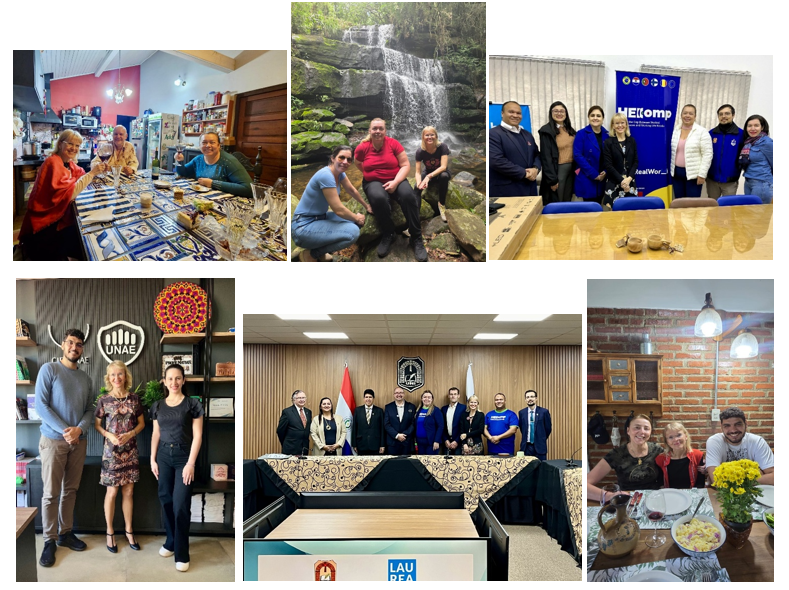
On and off work in Encarnación with Paraguayan colleagues/friends. Photo by E. Wainio.
In internationalization policies, strategic partnerships are seen as a key tool in improving the quality, impact and societal relevance of higher education. Based on my experiences, higher education internationalization and global partnerships are not only strategic alignments and institutional structures but, above all, connections and trust between humans, cultural sensitivity and commitment to joint development. That`s what meaningful, sustainable and impactful international cooperation is built on.
About the author
The author Elina Wainio, Senior Lecturer / Academic Mobility Coordinator, has a great interest towards international cooperation and cross-cultural activities on and off work. Thus, she is an experienced expert in various international and culture-related projects. By showing example herself, she encourages her students and colleagues to gain global competencies, which she also teaches.
Sources
- Brandenburg, U., de Wir, H., Jones, E. & Leask, B. (2019). Defining internationalisation in HE for society. University World News. Khalifa University. Accessed 22.1.2026.
- Britannica (2025). Encarnación | Port City, Paraguay River, Jesuit Missions | Britannica Accessed 20.1.2026.
- Heicomp (2025). Heicomp – #GoToRealWorld. Accessed 1.2.2026.
- Knight, J. (2004). Internationalization Remodelled: Definition, Approaches, and Rationales. Journal of Studies in International Education, Vol. 8 No. 1, Spring 2004 5-31.
- Knight, J. (2013.) The changing landscape of higher education internationalisation – for better or worse? Perspectives: Policy and Practice in Higher Education,17:3, 84-90. Accessed 20.1.2026.
- Kokko, T., Spens, K., Aholainen, R., Hakala, J., Hokkanen, J., Holmström, S., Lundin, K., Lähdeniemi, S., Paakkanen, I. & Vihma-Purovaara, T. 2020. Yhteistyössä maailman parasta: Korkeakoulutuksen ja tutkimuksen kansainvälisyyden edistämisen linjausten 2017–2025 seuranta ja kehittäminen. Helsinki: Opetus- ja kulttuuriministeriön julkaisuja 2020:14. Accessed 1.2.2026.
- Laurea (2025) Strategia 2035, Laurea-ammattikorkeakoulu Accessed 20.1.2026.
- Lewis, R. D. (2000) When cultures collide: managing successfully across cultures Brealey 2000. Rev. ed. Finland: WS Bookwell.
- Ministry of Education and Culture (2017). Better Together for Better World. Accessed 27.1.2026.
- Pedró, F. & Galán, V. (2022). International cooperation to enhance synergies. Paper commissioned for the World Higher Education Conference 18-20 May 2022. Accessed 22.1.2026.
- Wainio, E. & Escurra, L. (2025). Becoming Competent for the Globalized World. Laurea Long 17|2025. Accessed 27.1.2026.
- Wallin, A. (2013). Monikulttuuriosaaminen. Uudistuvan työyhteisön valttikortti. Klaava Media.
