The main goals for our staff mobilities were to advance future collaboration possibilities, to learn from each other and to widen perspectives on the PIONEER Alliance themes. The week connected many people from various fields of work and science and sparked ideas for new types of sustainable collaboration.
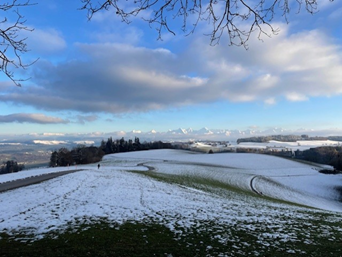
View on the Alps. Photo by Eeva-Kaisa Kinnunen
Berner Fachhochschule (BFH) belongs to the European University Alliance PIONEER as an associated partner. BFH has over 30 faculty buildings located in the Bern canton area. We had an opportunity to visit many of them during the international week 24-27, November 2025.
What can you expect from a study point of view if you travel to Bern and BHF?
BFH as a university of applied sciences is established 1997 and has eight departments, 32 Bachelor´s degree and 27 Master´s degree programmes. They have teaching in German, French and partly in English. The number of students is about 8000 and there are over 2800 staff members. (The BFH in Figures, 2025)
BFH has teaching in the fields of:
- Architecture, Wood and Civil Engineering
- Health Professions
- School of Agricultural, Forest and Food Sciences
- Bern University of the Arts
- Social Work
- Engineering and Information Technology
- Business
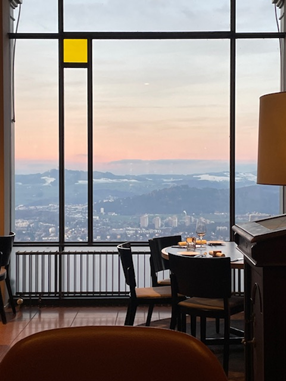
View over the city. Photo by Eeva-Kaisa Kinnunen
This PIONEER partner would be interesting for Laurea nursing, hospitality, social services, business information technology and business lecturers and staff members.
Making a connection and planning future collaboration
The BFH provided us with a program including inspirational and forward-minded living labs combined with motivational workshops and research-based lectures. The talks between the professionals from various fields of science during the week were full of enthusiasm regarding the Pioneer Alliance but also beyond. The willingness to collaborate between organizations and on an individual level to connect with people was at the centre of the BFH staff week atmosphere.
The welcoming keynote was from ETH Zürich, by Christian Pohl; “Real-world laboratories as learning opportunities”. There he described their transdisciplinary project with students, involving stakeholders. This learning method reminded us of the learning by developing model of Laurea (Laurea 2025). Finding such similarities in the pedagogical approaches makes BFH even more appealing partner for Laurea.
The hospitality during the week was given full attention to. One way of showing the guests how welcome they were was to bring everyone together for a welcoming dinner. We got to taste the famous Swiss fondue in the evening, which was delicious. One important aspect of international collaboration is the connection between people. Without the connection, the motivation to collaborate is lower. The BFH approach thus served its purpose and initiated the connecting process between partners.
Urban living laboratories to benchmark
The next day Sini visited the Urban Laboratory in the close by in the small city of Biel, presented by William Fuhrer. The Urban Laboratory is a collaborative initiative involving Biel’s professional and interest groups, the City of Biel/Bienne, and Bern University of Applied Sciences. Its mission is to analyze, support, and promote urban development processes. As a real laboratory for science bridging science, practice, and society, it fosters the exploration of social and spatial transformations through transdisciplinary dialogue. Ongoing, dialogue-driven processes accompany and shape developments, facilitating the identification and negotiation of complex interactions within urban dynamics. The visit also included a city walk where the thematics of city planning were discussed. Biel is a small city with only 55 000 residents, but it is called the smallest metropolis in the world, since it is a bilingual city, with German and French speaking residents. They have a lot of industrial societies, like mechanics and clocks.
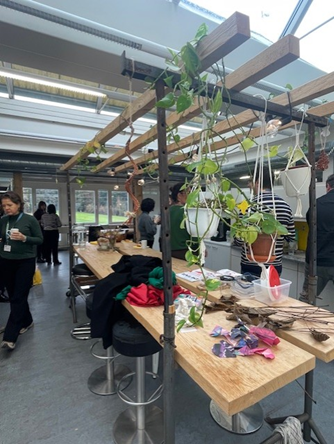
Urban living laboratory, co-creative planning of sustainable housing and community space combined with business. Photo by Eeva-Kaisa Kinnunen
The other urban living laboratory visit included a building site visit to a former office building which was being transformed into a multiuse building including a collective space for community activities, housing with small apartments and offices for local business. The living lab –crew was working together with the community, researchers, investors, and general workforce of local builders. A very sustainable approach which could be benchmarked for further development in Finland. This was the highlight visit of Kaisa´s week in Bern.
Sustainable food solutions
As the week continued, we both attended the workshop about Cities as drivers for sustainable food systems on Campus Zollikofen, outside Bern on the countryside. Ursula Kretzschmar and Claude Winter discussed how to launch innovative and local food products on the market and their project.
The BFH department of Agriculture, Forestry and Food Sciences is a driving force in the Swiss food innovation eco-system. Together with three partner organizations, the AgroFoodPark was founded in Zollikofen to give food companies a decisive advantage. We learned what steps are necessary from brainstorming to scaling up food. This worked as a catalyst on ideating new projects between partners, focusing on the Sustainable Development Goal 11, “Sustainable cities and communities” (United Nations, 2025) according to the Pioneer Alliance framework.
Using the AgroFoodPark in Zollikofen as an example, we learned how to work together in an ecosystem to achieve a decisive impact. We discussed many topics, like food poverty and different methods to tackle this issue. “Café Surprise” provided all with an example where anyone can buy two coffees and give the other one to a stranger. They also offer the solidarity menus, which are cheaper. The homeless have an app in Bern, where they can get help with finding food etc.
Exchange of thoughts- “The Nordic-model” is the winner
One of the most personal events of the week was the project space where every participant was able to choose a workshop or a project space to attend based on personal interests and specialties. Study opportunities and support for refugees resonated with Kaisa the most, and she took part in the conversations including Bern business school pioneers on the subject as well as the researchers collecting and looking into the data regarding the topic. We got to learn that Finnish system and the support provided for students in general is rather substantial and many researchers recommend the decision makers to benchmark from the Nordics.
Combining business and universities – research and projects to support cities ecosystems
Wednesday started with the workshop of “Value based participatory transformation”. There we heard the presentation of Merle Ibach about their research project. The project provides people with tools and opportunities to reconnect with places and empower them to contribute to their transformation towards sustainability. It explores how to improve participation processes in the context of the built environment using cultural probes in a contributory citizen science approach. We had the opportunity to experiment with this guided self-documentation and discover its benefits. We got a pack with play dough and ink and were instructed to go outside to collect details of the environment by modeling the play dough and making an ink painting of it. It was exciting to see how we all saw the same environment with different eyes. The project is part of the National Research Programme “NRP 81 Baukultur”.
This was followed by the Smart Cities Workshop of Stephan Haller, where we learned how technical infrastructures are becoming increasingly important for cities as they help make them more inclusive, safer, more resilient, and sustainable while contributing to achieving the SDG11 goals (United Nations 2025). By integrating smart technologies, digital twins, and data spaces, cities can, for example, optimize resource use, improve urban planning, and enhance the overall quality of life for their residents.
The morning also offered motivational workshops on how higher education institutions play a key role in driving entrepreneurship and how students, lecturers and researchers can be actively engaged in this process. The workshop explored strategies and activities that strengthen entrepreneurial thinking and action within universities. The session highlighted ways to create a dynamic academic environment that encourages innovation and new ventures. The connection between universities and the broader innovation ecosystem was at the core of the workshop. Presenters in both workshops were Lizanne Richle, Lorenz Probst and Roger Neuenschwander. Pioneer partners had the opportunity to reflect on their universities regarding the subjects, and the outputs of these discussions were collected for further processing. It was an interesting morning for Kaisa and served as an extension to the current discussions in Laurea; how to combine RDI with business.
Social sustainability and the impacts of the climate change
The most interesting visit for Sini was the visit to “Diverse Neighborhood for All” project and their spaces in Bethlehem area of Bern. The community area was called “Tscharnegut”. It was founded 1962 being the first community center in Switzerland. The apartment buildings were the first in Switzerland. The area was built for 5000 residents and was one of the first neighborhoods with no cars. The flats include 3,5 rooms. 45 per cent of the residents are foreigners. The migration started in 1950s, and the immigrants came from Italy, Portugal and the Balkans. The biggest challenges in the area are unseen poverty, large families, unemployment, social isolation, lack of competence in participation and this is why the area is called the “ghetto” of Switzerland. In the area they have support, gym, spaces for community, café, and common yard. Now the area is popular also among students. The rent is still 700-800 CHF, which is affordable. The is approximately 1/3 of the rent in the city centre. The houses must be rebuilt so rents will be higher making it more difficult for the people to stay there.
Simone Gäumann presented first their participatory interventions and diversity-sensitive participation opportunities in Bern West. The interventions were the neighborhood day in May when the church bells play songs of meaning that the residents can propose. This increases the sense of belonging and recognition. Another subject was portraits of playgroup leaders, who are the invisible supporters of the community, with very little recognition. They promote interaction by drawing workshops, eating together (“active supper”), observing, interviewing, and analyzing the aspects of the community. For example, 92 percent of the pupils in the nearby school have another mother tongue. The workshop was followed by a neighborhood tour in Bern West by Stephanie Schär where we got to see new developments building up.
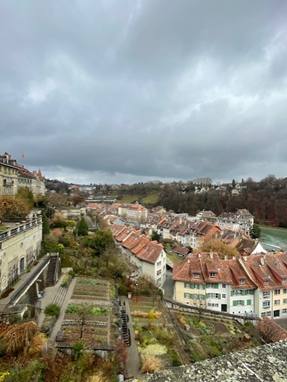
View on the riverside in Bern. Photo by Eeva-Kaisa Kinnunen
Meanwhile Kaisa participated in a tour to one of the Bernese cathedrals which was a very contractionary activity. On the other hand, there are people in the city living below the poverty line and on the other hand, there are people and foundations investing in restoring the churches. The research on the condition of the church is related to climate change, which of course is a subject to be taken seriously and understand that the impacts vary from the condition of houses to people living and experiencing hunger.
Connecting
The week had a beautiful final dinner which was a great opportunity to network with new colleagues and share international experiences in an old fire station transformed into a modern restaurant. Connecting was at the core of the evening, and many new possibilities for collaboration emerged during the dinner.
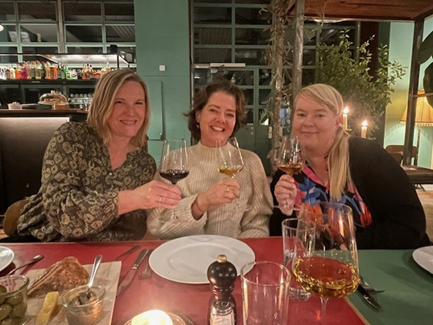
Pioneer partners connecting over a farewell dinner. Left Sandra Keetels-Snel (AVANS), middle Ria van Ooijen (AVANS), right Sini Aalto-Friman (LAUREA). Photo by Eeva-Kaisa Kinnunen
Bringing the ecosystem together
The last day we visited Sitem Insel Hospital area in Bern. This is one of the largest university hospital areas in Switzerland. They have 42 specialties, and the University of Bern has the largest medical faculty in Switzerland. The Sitem Insel is a building that offers spaces for different actors, BFH, startup club, simulation hospital spaces, applied research spaces, diabetes centre, clinical anatomy training, surgical robotics, artificial organs workshop, biomechanics spaces, spaces for MRI, epilepsy, stroke, muscle and skeletal diseases etc. 20 per cent of the spaces are for clinical use and the rest is for research. Sitem Insel Hospital showed us an innovative way of combining business and students, researchers and companies and RDI activities under one roof.

Sitem Insel, practise room for surgeons. Photo by Eeva-Kaisa Kinnunen
Future collaboration
The goal for our visit was to get to know BFH more and deepen the collaboration between our institutions in the PIONEER Alliance. Laurea staff members can visit Bern if they have collaboration proposals. There is a specific SEMP funding from Bern that can be used before Switzerland hopefully joins the Erasmus+ programme. Please contact Laurea International Services (sini.aalto-friman@laurea.fi) for more information.
The collaboration continues with Bern in the PIONEER Alliance, and we receive visitors from Bern to Laurea International Week. Even in this time of convenient virtual mobilities, face-to-face meetings are needed to create long-lasting relationships and networks. The international visit has enriched our professional perspectives and fostered valuable connections that we hope to continue in the PIONEER Alliance and after. In case you are interested in hearing more about the inspirational projects of Bern introduced to us during the staff week and if you want to discuss how we could aim for such projects in Finland and at Laurea, please contact eeva-kaisa.kinnunen@laurea.fi.
References
