Satu Bethell
22.5.2026

Pauliina Pöyry
22.5.2026

Berenice Rivera-Macias
22.5.2026
As entrepreneurship is a significant form of employment for international talents in Finland, fostering an entrepreneurial mindset is needed. To facilitate this, the IMIB Network team at Laurea developed and implemented workshops that invited participants to see entrepreneurship as a relevant career option, recognize their own potential, and provided them with essential tools to start developing their business ideas.
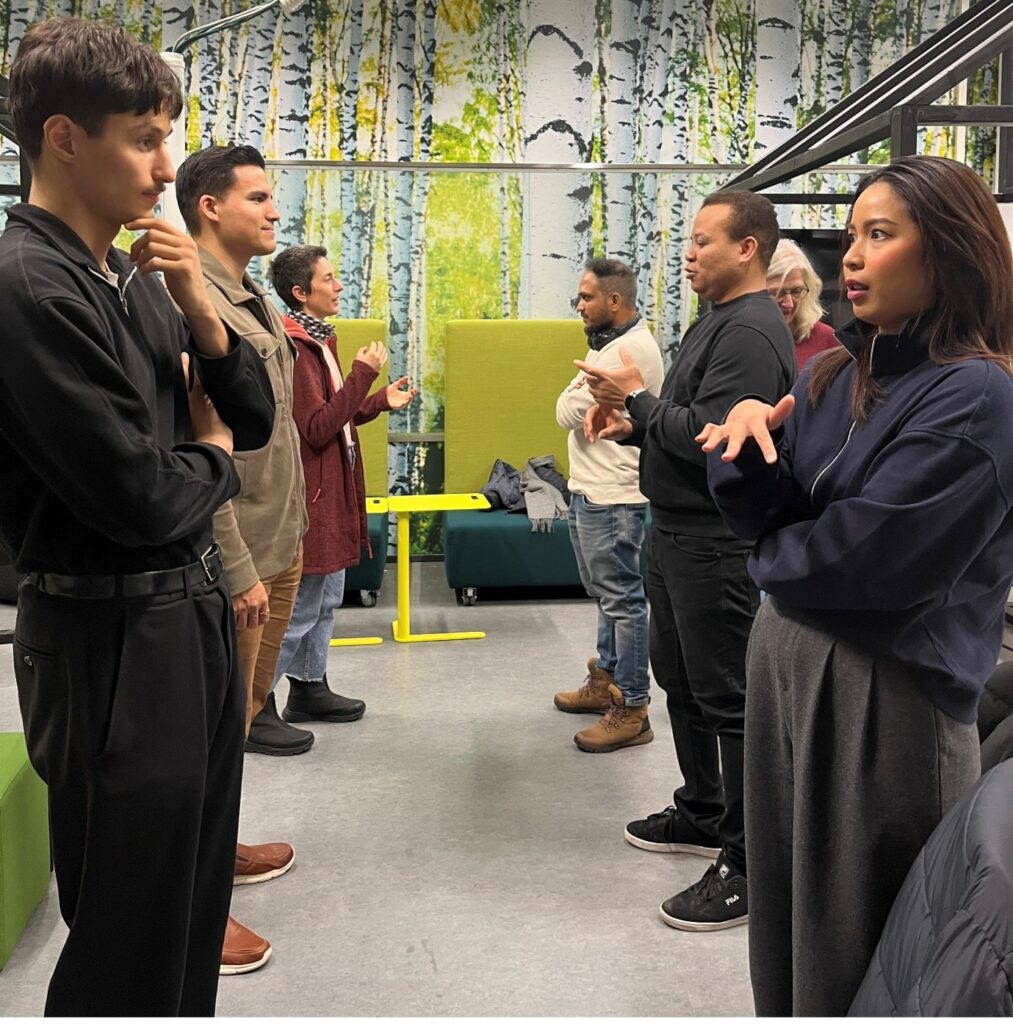
The collaborative entrepreneurship workshops organized as a part of the Immigrants as Business Mentors project concluded in April 2026 (Laurea UAS, 2026). Their collaborative nature came from inviting entrepreneurs of migrant background to share their entrepreneurial journeys, and from collaboration with NGOs such as Startup Refugees and Entrepreneurs of Espoo, as well as with IMIB Network team members from Haaga-Helia. This article provides a reflective perspective from the team behind the workshops based on theoretical foundations, feedback from the participants, and our own observations.
Finding one’s voice is a part of the entrepreneurial mindset
Ronald Barnett (2007), drawing on Batchelor (2006), discusses the importance of students’ own voice in higher education and identifies three dimensions of it: revealing one’s voice, reclaiming one’s voice, and finding one’s voice. This framework is highly comparable to our experiences with highly educated immigrants whom we coached in the IMIB Network.
For instance, for many of our participants it was essential to first recognize and acknowledge the voice shaped by their prior educational, cultural, and professional backgrounds and contexts, which we did through our approach. Rather than focusing solely on formal qualifications, the participants were encouraged to identify skills gained through employment, hobbies, and life experiences, thus broadening the understanding of expertise.
According to Barnett and Batchelor, reclaiming one’s voice involves rebuilding confidence and agency through supportive learning environments that allow space for experimentation, failure, and success. By contrast, finding one’s voice refers to the discovery of previously unrecognized potential, interests, or aspirations. In this sense, reclaiming and finding are related but distinct processes: reclaiming is about restoring or strengthening a sense of agency that may have been diminished, whereas finding is about uncovering new directions or possibilities that were not previously visible.
This distinction was reflected in participants’ experiences. As one participant noted, “after going through the program, I realized the specific service can be marketed and can be somehow profitable—I can make good use of my skills.” This illustrates how the process was not only about rediscovering confidence (reclaiming voice), but also about recognizing new opportunities and value in one’s existing competencies (finding voice), thereby linking personal agency with entrepreneurial action.
Building on this, finding one’s voice may also involve the emergence of new strengths in supportive environments. In the workshops, creative and reflective methods enabled participants not only to recognize previously hidden abilities, but also to translate these into a growing sense of agency and exploration of new possibilities, including entrepreneurial pathways. This process was illustrated by one participant who initially hesitated to join due to their strongly scientific disciplinary background. By the end of the program, however, they reported feeling ready to consider developing a business idea and to begin working on it with the support of an expert mentor—demonstrating how a supportive environment can move individuals from uncertainty toward active engagement and future-oriented action.
How did the workshops promote entrepreneurial mindset?
During the project, we ran four cycles of collaborative workshops, and each cycle consisted of four or five sessions based on creative methods. At the very core of our entrepreneurship training rested a belief that hope, self-efficacy, and a strength-based mindset are not only catalysts but also sustainers of an entrepreneurial mindset.
According to Luthans and Jensen (2002), self-efficacy and hope are core components of positive psychological capital. Having goals, finding pathways toward them, and believing in one’s ability to act represent essential entrepreneurial competencies, which can be effectively strengthened through creative and participatory methods. In the coaching context, hope and self-efficacy played a central role by enabling participants to navigate uncertainty and pursue opportunity-driven goals.
The workshops focused on building the inner capacity to believe in one’s vision, to take concrete steps despite uncertainty, and to keep going despite setbacks. One key concept was resilience, which was constant in our conversations with the participants and the visiting entrepreneurs. Feedback such as “Turn your obstacles into strength” and “Done is better than perfect” reveal how participants internalized both a resilient and action-oriented mindset.
The importance of hope, self-efficacy and action-based mindset was affirmed through the voices of our participants, each reflecting on their journey, their learning, and their growth. Feedback highlighted the ways through which the workshops’ creative and collaborative exercises strengthened their ability to connect with others and apply creative mindset. In their feedback, participants shared powerful moments of self-awareness.
As one participant put it, “It is not impossible to be an entrepreneur even as an immigrant in Finland (hope).” Another noted, “I learnt that I have unused potential that I could use to progress myself in my entrepreneurial dream path.” These reflections point to a fundamental shift—not just in knowledge, but in self-perception and identity.
“The entrepreneur story was good—it gave hope to new entrepreneurs,” one participant said about the visiting immigrant-background entrepreneurs, echoing the power of shared experiences in cultivating confidence. Moreover, creative methods acted as gentle bridges by unlocking intuition, emotional insight, and a deeper connection with one’s aspirations. As one participant observed: “Therole of creativity in entrepreneurship is surprisingly broad – it goes far beyond just idea generation.” Another participant noted that the pitching exercise, though intimidating at first, became a transformative learning experience: “The pitch exercise demonstrated that pitching is a valuable skill that can be effectively applied beyond entrepreneurship as well. “
Conclusion
Based on all the above, as a team, we learned throughout the workshops that people need time and space to grow their ideas and to recognize their competencies. Moreover, people have a need to be seen and heard; and learn from each other’s experiences. For immigrants, networking does not come easily here in Finland, and peer support and networking opportunities within and outside the workshops was very valuable. Furthermore, to make people feel comfortable sharing their thoughts, experiences and ideas, an environment of trust is needed.
On the other hand, there is a need to balance these perspectives with practical guidance and support towards entrepreneurship in practice, as some participants also suggested in their feedback. The participants were in different stages of their entrepreneurial journeys, and for that reason, we also offered additional mentoring to those who needed more support in developing their business ideas. Participants from previous cycles have expressed their need for continuous support even after the end of the project itself. This is because the entrepreneurship journey is a long and challenging one, and there is always a need for support.
Additionally, we have understood that there is a need to facilitate similar sessions to aspiring entrepreneurs, particularly international students across all fields at the universities of applied sciences. The latter is due to the current and future job market trends where professionals are expected to develop their own businesses.
In essence, at the core of the workshops were the possibility, resilience, and the belief that everyone has the capacity to grow, contribute, and thrive as entrepreneurs. When individuals are met with encouragement, meaningful reflection, and creative tools, something powerful happens – hope is reignited, and the courage to act becomes real.
Because in the end, entrepreneurship isn’t just about launching a business, but about realizing that you have what it takes. And sometimes, that first spark is all you need to ignite a path filled with purpose, possibility, and impact.
The IMIB Network has been developed in the Immigrants as Business Mentors project, which is a 3UAS project co-funded by the European Social Fund (ESF+). The project is coordinated by Haaga-Helia UAS with Laurea UAS and Metropolia UAS acting as project partners.

AI has been used for text editing.
References
- Barnett,R. 2007. A Will to learn. Being a Student in an Age of Uncertainty. New York: Open University Press.
- Batchelor, D. 2006. Vulnerable voices: an examination of the concept of vulnerability in relation to student voice. Educational Philosophy and Theory, 38(6):787-800.
- Bethell, S. & Pöyry, P. 2025. Creative Methods and Collaborative Learning as Enablers of Entrepreneurial Spirit. Laurea Journal.
- Creative methods and collaborative learning as enablers of entrepreneurial spirit |
- Laurea UAS 2026. IBM: Maahanmuuttajat yritysten mentorina (Immigrants as Business Mentors).
- Luthans, F., & Jensen, S. M. 2002. Hope: A New Positive Strength for Human Resource Development. Human Resource Development Review, 1(3), 304-322.