Out of 180000 applications that the Finnish Immigration Service had received in 2025, 80000 applications were made by female immigrants (Finnish Immigration Service, 2026). Even though the reasons were mostly connected with the families, it is important to note that, according to the National Report of Finland (EMN Study 2022, 2022), foreign females tend to have a slower progression of the career. To aid immigrant women seeking employment, a project supporting the development of skills and networking was created.
The CeMeWE project, or Central Baltic Mentoring for Migrant Women seeking Employment, is a valuable project that focuses on the integration of immigrant women in the labor market. Overall, it is implemented in 4 countries with 2 branches in one. Sweden, Estonia, Finland, and Latvia (both in Riga and Zemgale Region) are the main regions for the work of the CeMeWE. With over 1000 participants overall, this project has shown brilliant results and produced success stories. To ensure that all the partner countries are aware of the results and activities, various partner meetings were held. The most recent one happened from the 3rd of February until the 5th of February at Riga Technical University, Latvia. Even though the achievements were the main part of this meeting, it also promoted female empowerment and enlightened the future path for the project.
The Project Partner Meeting
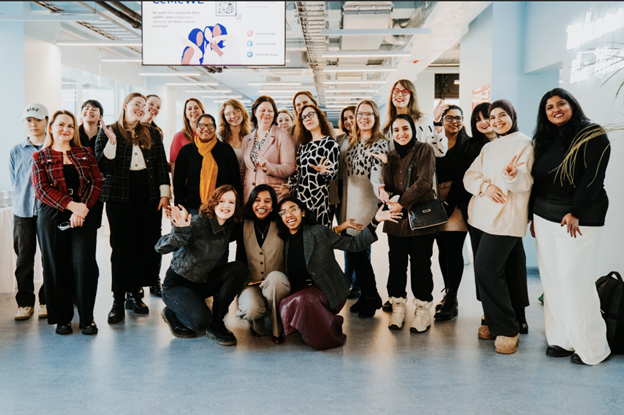 The Participants of The Empowering Women Conference (Babre A.M.)
The meeting was not only a productive discussion, but also a valuable experience for every partner. As the main work tools for the CeMeWE are mentoring and peer support groups, each country has found its own approach to the target audience. While Zemgale Planning Region was focused on art therapy and creation of the roadmaps from collages, the Upsala Region and the Institute of Baltic Studies implemented the SMILE approach. Moreover, Riga Technical University and Laurea University of Applied Science, by targeting different age groups and education levels, organized professional skill development-oriented workshops. As each partner country had a unique approach, it was important to share the experiences and discuss the successes and challenges of each peer support group.
Another discussion topic concerned the completion of the necessary documentation and goal setting. As the project is at its final stage, it is important to understand the prospects of the CeMeWE project and how to motivate immigrant women to continue growing both their network and learning new skills. Even though the project has shown that by educating immigrant women, it is possible to ease their introduction to the labor market, there should be an indicator that the achievements of the project are going to have a positive impact even after it is closed.
Furthermore, to share the success stories and to promote the project, the conference “Empowering Migrant Women” was organized during the meeting in Riga. Each partner had an opportunity to present their own project implementation and activities, as well as answer questions from the audience. The event started with a presentation from Andra Marta Babre about the statistical results that CeMeWE Riga had achieved. Then, Sanna Hämäläinen from Laurea University of Applied Science showed the activities that were conducted within the project in Finland. Afterwards, Inga Dāboliņa spoke about the Textile Testing Course and the activities done within the course. Kristiina Tomik introduced the struggles that women encounter in the Estonian job market, as well as showed the events that happened during the CeMeWE project implementation in Estonia. After lunch, the stage was taken by Kina Nordlund from the Region Uppsala, who shared her experience of working and organizing SMILE groups. Then, Ieva Zeiferte and Diāna Kačane from the Zemgale planning region shared the stories of Ukrainian women who reached out to them and showed the changes that occurred in their lives after participation in the CeMeWE.
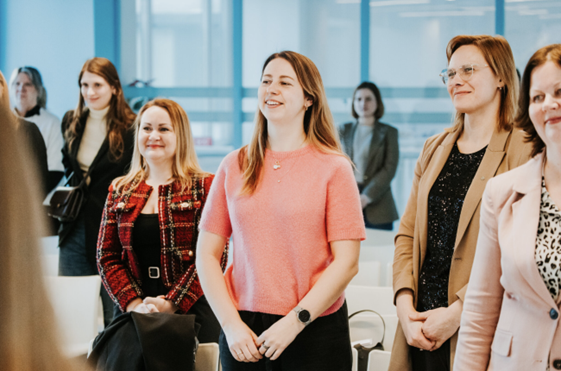 Public of the Conference Empowering Migrant Women (Babre A.M.)
To conclude, open communication between the partners via both meeting in person, online and emails is enhancing the results of the project. By discussing obstacles and trying to overcome them with the experience of the partner country, the chance of gaining desirable results is increasing. Furthermore, as some events of the CeMeWE project were hosted in an online format, communication and updates on the activities allowed such events to be promoted and attended by those immigrant women who truly needed them.
This activity was supported as part of Project – Central Baltic Mentoring for Migrant Women seeking Employment – CeMeWE CB0100070, as Interreg Central Baltic Programme 2021-2027 project co-funded by the European Union.
Authors
- Antonina Petrovic (PhD, PM) is a social scientist who works at Laurea University of Applied Science, Senior RDI Specialist and Project Manager.
- Julita Viļuma is a IVY volunteer of the CeMeWE project at Laurea University of Applied Science.
References
