Sini Aalto-Friman
5.6.2026

Maryan Hussein
5.6.2026
The PIONEER Mobility Workshop in Huelva demonstrated how PIONEER supports Laurea in translating strategic objectives into action through more accessible mobility opportunities, harmonised practices across partner universities, and the continued development of COIL and Blended Intensive Programmes (BIPs). Together, these initiatives help embed international collaboration more systematically into education, services and institutional development.
Introduction: PIONEER as a platform for strategic internationalisation
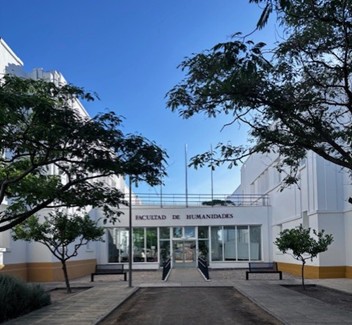
Laurea delegation participated in the PIONEER Mobility Workshop at University of Huelva 5-7 of May 2026. Laurea belongs to the PIONEER European Alliance with nine other European partners. “The alliance develops diverse and future-oriented educational offerings that respond to the competence needs of European cities in sustainable development and supports the capacities of students, experts, residents and urban actors to operate in a changing world.” (Laurea 2025). The Alliance works 2025-2028 promoting UN Sustainable Development Goal to make cities and communities inclusive, safe, resilient and sustainable (Goal 11: Sustainable Cities and Communities). Inclusion is also the topic of work package 2, making mobility possible for all. Sini is also the leader for work package 3 EDI (Equality, Diversity and Inclusion) & Mobility Pilot, where inclusion is the main objective as well.
International student mobility has proven to be highly valuable for students in gaining the competences needed for personal, educational, and professional development (European Commission, 2023). Moreover, it helps increase intercultural understanding and foster a common European identity (European Commission, 2023). These are essential topics in PIONEER. There are barriers to mobility that PIONEER and PIONEER Mobility and Internationalisation Plan try to address, for example these four different obstacles for international mobility: practical, social, financial, and motivational obstacles (Muja, Mensvoort & Cuppen 2024.)
From mobility planning to inclusive internationalisation
The event was for PIONEER work package 2 (WP2) delegates, international office representatives and for vice rectors of internationalisation. Sini Aalto-Friman is the WP2 delegate, key action leader and the international office representative. Maryan Hussein is the international office representative and Katri Ojasalo was joining the session for the vice rectors.
The main objective for the event was to discuss and finalize the PIONEER Mobility and Internationalisation plan that WP2 is working on this spring. PIONEER Mobility and Internationalisation Plan constitute Deliverable 2.1 in the PIONEER project. This deliverable is due by summer 2026, and it is expected to be implemented between 2026 and 2028.
The main strategic priorities covered in this plan are:
- Making international mobility possible for all
- Harmonising mobility management across the PIONEER Alliance
- Global minds, local actions
- Achieving real-world impact
Sini is the key action leader for these actions belonging to the strategic priority of “Harmonising mobility management across the PIONEER Alliance”:
- Development of the PIONEER Staff Exchange Program
- Coordinated organisation of PIONEER International Weeks and institutional visits
The PIONEER Mobility and Internationalisation plan is a guiding document, which all partners follow in the way they can. Laurea International Services will monitor and choose main topics that will be developed in Laurea in the years to come and for some other topics we take part in with smaller focus. Staff visits and international week organization Sini will continue with, belonging to her normal work in Laurea. It is recommended that Laurea staff members visit PIONEER partners during the project time and plan sustainable future cooperation together.
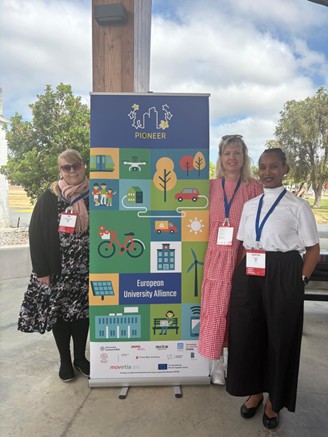
During the week we discussed all the key actions in these three participant groups. Finally, the key actions were presented in the plenary session and discussed together. We also joined the PIONEER festival outside, where we got the task of organizing different causes of human actions, regarding the environment. We also presented PIONEER and Laurea to the visitors.
Embedding internationalisation into everyday practices
From Strategy to Practice: Advancing Internationalisation Through PIONEER
At Laurea, internationalisation is not only about mobility volumes but about embedding global competence across education, RDI activities and staff development. Discussions during the Huelva workshop in May highlighted a shift from fragmented activities across PIONEER partner universities towards more systematic, visible and integrated practices that support Laurea’s long-term strategic goals. This development reflects the dual nature of universities as organisations shaped by both formal structures and informal norms, where coordinated practices help bridge strategy and everyday academic work (Maassen & Olsen 2007 as cited in Maassen et al. 2023).
Laurea’s participation in the PIONEER Alliance demonstrates how institutional strategy can be translated into practical development work that directly supports education, mobility and international cooperation. The workshop brought together alliance partners to align processes related to Blended Intensive Programmes (BIPs), virtual mobility and international collaboration, while also examining how alliance-level objectives can become part of daily higher education operations.
The discussions strongly reflected the ambitions of Laurea Strategy 2035, particularly the goals of international impact, accessible collaboration and future-oriented learning ecosystems (Laurea 2035). Rather than viewing internationalisation as a separate activity, the workshop highlighted how it can be embedded into curricula, mobility structures and institutional planning.
A key element of this transformation is the harmonisation of practices across partner institutions. This closely reflects broader findings on European university alliances, where institutions have developed coordination mechanisms to align organisational practices, particularly in areas such as mobility schemes, quality assurance and data sharing. These mechanisms often take the form of shared standards and common guidelines rather than strict regulations, functioning as “soft” coordination tools that are nevertheless essential for the effective internal functioning of the alliance (Maassen et al. 2023)
From Laurea’s perspective, this work is strategically significant because it strengthens the student and staff experience while making international opportunities more accessible and transparent. Concrete examples discussed during the workshop included shared information templates, aligned communication practices, improved feedback collection and clearer recognition processes to support continuous quality development.
The workshop also explored how virtual exchange, Collaborative Online International Learning (COIL) and blended mobility can support internationalisation at home. These models enable students and staff to gain international competence even when physical mobility is not possible. For Laurea, this directly supports the strategic objective of widening participation in international learning and embedding global collaboration into everyday teaching practices.
Building Long-Term Strategic Value for Laurea
An important strategic discussion concerned how PIONEER objectives should be integrated into Laurea’s operational planning. In Laurea, TTS (toiminnan ja talouden suunnittelu, Operational and Financial Planning) refers to the institutional action and financial planning process that guides how strategic objectives are implemented in practice across units and degree programmes. The workshop reinforced the need to connect alliance activities more closely with Laurea’s TTS planning, curriculum development and field-specific internationalisation plans. This helps ensure that participation in European university cooperation is not isolated project work, but part of long-term institutional development.
Overall, the Huelva workshop illustrated how European university alliances can function as strategic platforms for innovation, cooperation and institutional renewal. For Laurea, the value of PIONEER lies not only in international visibility, but in its ability to connect strategic goals with practical actions that benefit students, staff and the wider higher education community.
Conclusion
Laurea continues the PIONEER collaboration in all the work packages and is a strategic priority for Laurea. Each work package promotes various actions towards, for example challenge-based education, open campus, mobility, research and communication. All activities are linked to SDG11 goals.
We at Laurea invite all staff members to meet PIONEER visitors while they are visiting Laurea. Great example is the annual Laurea International Week that gathers participants from PIONEER and other partner universities to Laurea for a week to co-create, network and plan future activities together. We aim that all Laurea staff members will get to know PIONEER, meet new colleagues for inspiration and plan collaboration together. An easy way to get to know PIONEER destinations is to go for a teacher or staff exchange week (2-5) days, either an organized international week or tailor-made visit.
Artificial intelligence has been used to edit and harmonize existing text.
References
- European Commission (2023). Proposal for a council recommendation ‘Europe on the move’ — learning mobility for everyone. Available at: https://erasmus plus.ec.europa.eu/sites/default/ files/2023-11/europe on-the-move-recommendation-COM_2023_719_1_ EN.pd Accessed 21.5.2026
- Laurea 2025: PIONEER Alliance – Laurea University of Applied Sciences Accessed 20.5.2026
- Laurea, Strategy 2035, Strategy 2035 – Laurea-ammattikorkeakoulu
- Maassen, P., Stensaker, B. & Rosso, A. 2023. The European university alliances—an examination of organizational potentials and perils. High Educ 86, 953–968. Accessed 18.5.2026
- Muja, A., Mensvoort, C., & Cuppen, J. (2024). Studying abroad for everyone? Obstacles for inter national mobility among students in EHEA-countries. EUROSTUDENT 8 Intelligence Brief, IB_International-mobility.pdf Accessed 21.5.2026
- United Nations. Goal 11: Sustainable cities and communities – The Global Goals. Accessed 20.5.2026
Attachment:
PMIP content
1. Making international mobility possible for all
1.1 Establishment of incentives to students going to PIONEER destinations
1.2 Delivery of local language courses for prospective incoming students and foreign languages for prospective outgoing students
1.3 Development of a PIONEER Welcome Pack for incoming students at every partner institution (cultural immersion, safety, sustainability)
2. Harmonising mobility management across the PIONEER Alliance
2.1 Creation of a PIONEER Mobility Directory to improve interactions between international office staff and Mobility Offices.
2.2 Publication of every partner’s academic offer in English on the PIONEER website
2.3 Harmonisation of BIP organisation and recognition
2.4 Implementation of the PIONEER Visiting Professor Program
2.5 Development of the PIONEER Staff Exchange Program
2.6 Coordinated organisation of PIONEER International Weeks and institutional visits
3. Global minds, local actions
3.1 Consolidation of a unified definition of COILs and elaboration of a common protocol for their organisation across PIONEER partners
3.2 Elaboration of a measurement framework for virtual experiences and collection methodology for virtual experiences data
3.3 Internationalisation at home activities for academic and administrative staff at partner universities
4. Achieving real-world impact
4.1 PIONEER Internship Program and stakeholder engagement in PIONEER educational activities
4.2 Cross-cultural competence training
4.3 PIONEER Volunteering Program