Timo Savolainen
15.4.2026
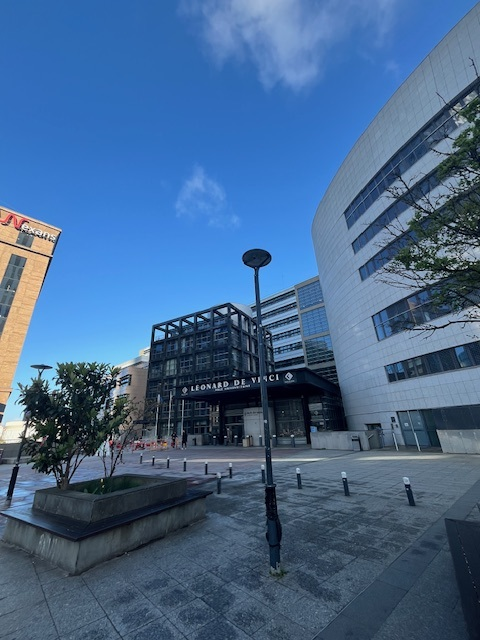
I participated with my colleague in an Erasmus teacher exchange from 30 March to 3 April 2026 during an International Teaching Week organised by De Vinci Higher Education (Pôle Léonard de Vinci) in Paris. The host organisation was De Vinci Higher Education, which includes, among others, EMLV Business School and ESILV Graduate School of Engineering. This was my first teacher exchange, and it was totally new and exciting experience.
De Vinci Higher Education is a familiar Erasmus partner for Laurea University of Applied Sciences through student and staff mobility, and students from this consortium have previously participated in exchange studies at Laurea. This existing cooperation formed the basis for the teacher exchange and enabled pedagogical experimentation without the need for a separate special arrangements.
The target group consisted of Bachelor-level engineering and business students. The teaching was delivered in English to several different student groups during the same teaching week. The exchange involved hands-on teaching in a multidisciplinary and international learning environment, with an emphasis on pedagogical planning, active student engagement, and team teaching. The international teaching week created an exceptionally intensive learning context in which students were exposed to multiple different pedagogical approaches. This also provided us a setting for examining themes related to safety and risk management from a learning environment perspective, which my particular area of interest.
Practical Arrangements and the Importance of Anticipation
A change to the teaching week schedule required us to reschedule flights and extend the accommodation, highlighting the importance of a clear risk treatment plan in international projects. Flexible booking options proved essential, as otherwise the costs would have become excessive. Although digital self-service tools were available, traditional customer service was more effective in managing these changes.
Travel conditions were mostly routine: flights were slightly delayed and comfort was limited, while local public transport functioned efficiently and sustainably. It is advisable to install the ÎDF Mobilités app and use public transport in Paris. The host university’s reception and orientation were well organised and clearly communicated. Overall, these practical arrangements supported predictability and reduced cognitive load, contributing positively to both safety and the sense of security for staff and students.
Teaching Design and Pedagogical Approach
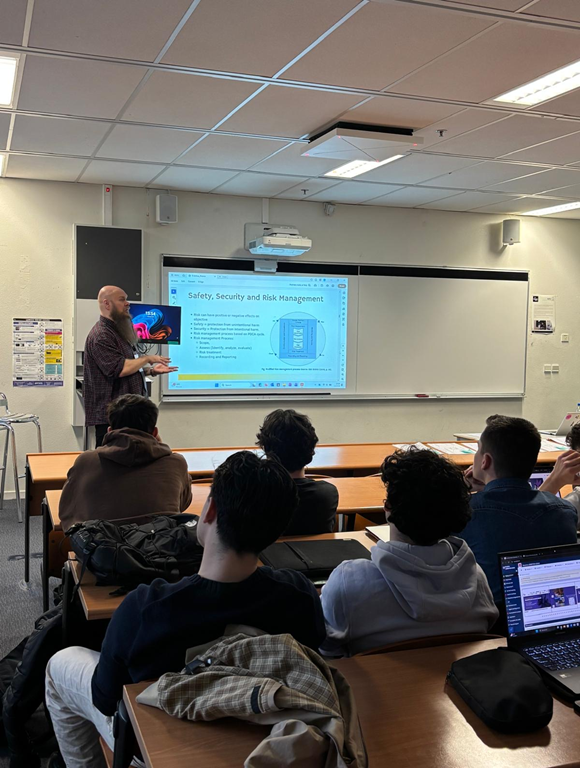
The teaching was delivered at De Vinci Higher Education’s La Défense campus in Paris. My colleague was primarily responsible for the content related to service design and design thinking, but the teaching material was developed in close collaboration from the beginning. My own role focused on safety, risk management, and the safe learning environment perspective. In other words, we delivered the introductory lecture together, complementing each other’s contributions. I primarily introduced the different exchange and mobility opportunities available at Laurea University of Applied Sciences and then moved into a more detailed discussion of risk management and campus safety. My colleague complemented the lecture by introducing students to service design and design thinking.
The practical exercise itself was carried out collaboratively. We presented the students with a development task, which was completed step by step. During these phases, I circulated around the classroom, supporting and guiding the students in carrying out the task. At the end of each lesson, the students presented their outputs, after which we continued the teaching by explaining how the entire process is connected to safety.
The pedagogical approach was based on the idea that safety is not a separate theme or an isolated “add-on”, but a principle that cuts across the learning environment and can be made visible through pedagogical choices, learning activities, student engagement, and various physical and digital solutions. At the beginning of the allocated teaching time, theoretical foundations were introduced, after which students began developing ideas for solutions that could improve safety in educational institutions. These activities Key frameworks, student work, pedagogical observations and general reflections about the whole teacher exchange week experience are discussed in more detail in the following subsections.
Key Frameworks
At the beginning of the teaching package, students were introduced to the following key frameworks and concepts:
- The Universal Design for Learning (UDL) framework, which is built on three core principles: multiple means of engagement, representation, and action and expression (CAST, 2024). UDL provided students with a concrete language and structure for considering inclusivity and safety from a learning environment perspective.
- The risk management process in accordance with ISO 31000, including defining the context (scope), risk identification, analysis and evaluation (risk assessment), risk treatment, and documentation and reporting (ISO, 2018).
- The conceptual distinction between safety and risk, where safety is understood as a goal and risks as sources of uncertainty that may have both negative and positive effects on achieving objectives (ISO, 2018).
- The safe learning environment framework, in which learning environment safety is formed through psychological, social, pedagogical, and physical dimensions (Savolainen, 2023).
- Core principles of service design and design thinking, such as user-centredness, iteration, co-creation, and prototyping (Stickdorn et al., 2018; Design Council, n.d.).
The purpose of these frameworks was not to overload students with theory, but to establish a shared conceptual foundation on which practical work and actual service design methods can be used.
Student Work and Pedagogical Observations
Following the theoretical introduction, students worked in groups using service design methods. Their task was to develop digital and/or spatial risk treatment solutions that could improve either the safety of the learning environment or the perceived sense of safety.
Students participated actively, and the working approach was highly energetic. Classroom situations involved a great deal of discussion and vocal interaction, which differed to some extent from Finnish student culture. The teaching space itself was structurally better suited to traditional lecture-based teaching due to fixed desk arrangements. It was particularly effective for the opening section, the theorical part—but from a group work perspective the space was partly impractical. Despite this, the atmosphere in the room was very high and the groups developed a range of diverse and surprisingly well-developed ideas.
Noteworthy examples included:
- A modular learning space chair that allows for rest positions and accounts for learners’ diverse physical and cognitive needs. This solution is directly linked to UDL thinking and inclusive learning environment design (CAST, 2024; Savolainen & Kärpänen, 2025).
- A digital application that allows students to anonymously report safety observations and concerns, while also receiving information about risks identified by the institution.
Students highlighted in many cases that anonymity lowers the threshold for raising safety-related issues. This observation aligns with psychological safety theory, which suggests that in psychologically safe environments individuals feel able to voice concerns, observations, and critical views without fear of negative consequences for their position within an organisation (Edmondson & Lei, 2014). An application that enables anonymity reduces the psychological risk associated with reporting and thereby supports students’ willingness and readiness to report safety observations. Service design methods provided concrete tools for this and supported the development of risk treatment solutions in line with the ISO 31000 framework (ISO, 2018).
Learning Environment, Practices, and Technological Support
The host institution used the Moodle learning platform, and students were registered electronically as present approximately 15 minutes after the start of teaching. This ensured attendance. Together with my colleague, this led us to reflect on how attendance and participation are monitored in different higher education institutions, and how these practices can shape teaching methods. In practice, this enabled a full classroom and the delivery of genuinely communal teaching.
The technological platform was good and easy to use. The team teaching proceeded smoothly, despite some differences from the systems we typically use. In addition, each session had a designated IT support person, which facilitated teaching implementation and reduced the workload and stress level for teachers.
Reflection and the Importance of Collaboration
This teaching visit was my first and constituted a significant professional learning experience. It enabled me to revisit core principles and methods of service design through hands-on team teaching, which was particularly valuable given that my everyday work tends to focus on more traditional research methods. This experience will also support my future supervision of thesis projects in which students employ non-traditional research approaches.
Team teaching helped me to see how design thinking and service design can naturally be integrated with risk management. Once the risk management context has been defined, risk assessment conducted, and decisions on risk treatment made in accordance with ISO 31000:2018, user-centred methods prove especially effective in the prevention and mitigation of risks.
The teacher exchange strengthened instructional collaboration between Laurea University of Applied Sciences and De Vinci Higher Education, providing a strong foundation for deeper collaboration in the future.
Conclusion
The teacher exchange in Paris concretely demonstrated how multidisciplinary and international team teaching can enrich learning for both students and teachers. The integration of service design, design thinking, and risk management provided students with a functional framework for developing digital and spatial solutions aimed at improving safety.
The solutions developed by students, which can be considered preliminary prototypes, illustrate that learning environment safety is closely linked to pedagogical, social, and organisational structures. Furthermore, they demonstrate that service design methods offer a practical framework for ideating and developing service-oriented, technical, and administrative solutions as part of promoting safer learning environments.
References
- CAST 2024. Universal Design for Learning Guidelines (UDL Guidelines 3.0). Accessed 19 February 2026.
- Design Council n.d. The Double Diamond. Accessed 19 February 2026.
- Edmondson, A. C. and Lei, Z. 2014. ‘Psychological safety: The history, renaissance, and future of an interpersonal construct’, Annual Review of Organizational Psychology and Organizational Behavior, 1(1), pp. 23–43.
- ISO 2018. ISO 31000: Risk management – Guidelines. Geneva: International Organization for Standardization.
- Savolainen, T. 2023. ‘A safe learning environment from the perspective of Laurea University of Applied Sciences safety, security and risk management students and staff’, Heliyon, 9(3), e12836.
- Savolainen, T. & Kärpänen, T. 2025. ‘Creating Safer Learning Environments Through Universal Design for Learning Framework’, in Human Interaction and Emerging Technologies (IHIET 2025), Vol. 197, pp. 100–110.
- Stickdorn, M., Hormess, M.E., Lawrence, A. and Schneider, J. (2018) This Is Service Design Doing: Applying Service Design Thinking in the Real World. Sebastopol, CA: O’Reilly Media.
Microsoft 365 Copilot is been used as to tool to improve grammatical accuracy and sentence flow of this article.