
Imagine finding a nude image of yourself online. The face is yours, but the image was never taken. Generative artificial intelligence and so-called nudify apps have made this possible. Although the image is technically fake, the shame, fear, and uncertainty it causes are real. This is precisely why the phenomenon has become both a criminal justice issue and a matter of wider social concern (Vehkoo & Uggla, 2026).
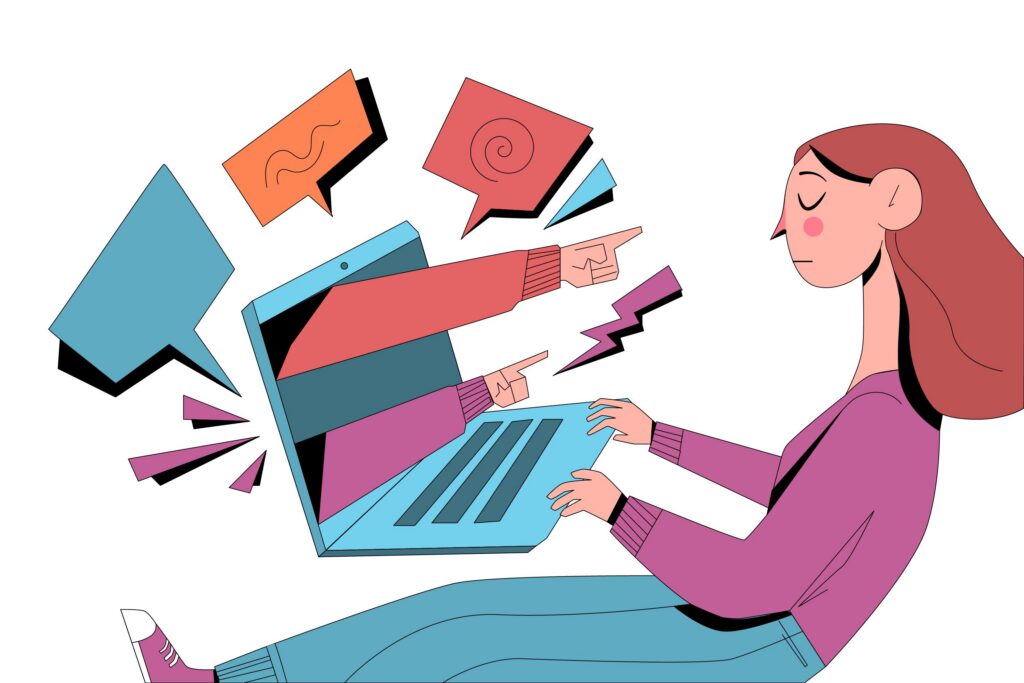
“It’s Just a Fake Image”: Why Dismissal Hurts
Being targeted through a nudify app does not feel, primarily, like a technological experience. It feels as though someone has taken it upon themselves to decide how your body is portrayed. Many victims describe the experience as a loss of control. A study by McGlynn et al. (2021) interviewed 75 victim-survivors of image-based sexual abuse in the UK, Australia and New Zealand. The researchers describe five connected harms: social rupture, constancy, existential threat, isolation and constrained liberty. The concern is not limited to the image itself, but also extends to where it is shared, who sees it and how far it may spread. Knowing that what happened can never be fully undone may continue to trouble a person for a long time.
One of the most common reactions is to point out that the image is not real. This, however, misses the point. From the victim’s perspective, the issue is not whether the image is authentic, but whether they consented to its creation. The core of the problem is that someone has used a nudify app to create a sexualised image of another person without permission. When the experience is dismissed because the image was generated by artificial intelligence, attention shifts away from the act itself and its consequences. Research supports this view: in an Australian interview study, victim-survivors described, in addition to the harms typical of image-based sexual abuse, anxiety about whether others would believe the image was fake and the burden of disproving it (Flynn et al. 2026).
Digital Misogyny Does Not Originate in Algorithms
Artificial intelligence is not inherently misogynistic, but it can be used in ways that reflect attitudes already present in society. This is precisely why nudify apps are often associated with digital misogyny. It is reasonable to ask why women are so often targeted by these apps and why their marketing is largely built around the sexualisation of women. Gibson et al. (2025) studied 20 popular nudify websites and found that most of them are explicitly aimed at “undressing” women, not all people. The problem lies not only in the technology, but in how nudify apps are used as instruments of power, harassment, and humiliation. A recent scoping review found that publicly available AI-generated sexual content on selected websites overwhelmingly depicts women, although prevalence studies paint a more complex picture. The authors place the phenomenon within technology-facilitated gender-based violence (Witt et al., 2026).
Norwegian columnist Helle Lyng Svendsen recently challenged the Prime Minister of India to answer questions from the free press. As a result, she has received a huge amount of negative feedback, including attempts to shame her with deepfake images that show her in a bikini (Mykkänen 2026).
Harassment on an Industrial Scale
Sexual harassment is not a new phenomenon, but artificial intelligence has transformed its scale. In the past, comparable conduct required more time, effort, and source material. With a nudify app, an ordinary profile picture may now be enough. This makes the phenomenon particularly alarming. According to Graphika (2023), 34 nudify services had more than 24 million unique visitors in September 2023. The report says that this activity has moved from small online forums into an automated business that works at scale. It is no longer only a matter of isolated cases, but of harmful content being produced and distributed quickly and at scale.
The phenomenon is not merely a distant threat. In August 2026, a case became known in Lappeenranta, Finland, in which an underage boy is suspected of using artificial intelligence to create nude images of several underage girls. The police initially received more than a hundred reports of offences in connection with the case, and by the end of October they had positively identified forty-five victims. According to police estimates, the number of victims may rise to around fifty. (Poutiainen 2026). It has not been publicly disclosed whether the images were created specifically with a nudify app or with some other AI tool. From the victim’s perspective, however, this makes no difference, as the outcome is the same: a sexualised image of them has been created without their consent. The case shows how a single perpetrator can use artificial intelligence to harm dozens of people, and how fear spreads even among those who cannot be certain whether images of them exist.
Attention often focuses on the person who created the image. The victim faces an entire ecosystem: the nudify app itself, the platforms on which the image is distributed, the users who circulate it and, at times, the indifference of those around them. It is therefore not merely the act of one person, but part of a broader digital environment that enables and sometimes even normalises such conduct. This environment is supported by the features of the websites and by the payment systems behind them, such as credit cards and cryptocurrencies (Gibson et al. 2025). The services are also marketed on Reddit, X and Telegram (Graphika 2023).
Why Have Nudify Apps Become a Political Issue?
The discussion has shifted from individual offences to the services themselves. Critics argue that the primary purpose of nudify apps is to create sexualised content depicting people without their consent, and that access to such apps should therefore be restricted. Others maintain that the problem lies with users rather than the technology. The debate nevertheless shows that nudify apps are no longer regarded merely as a technological innovation, but also as an issue of human rights, safety and human dignity.
Research also supports a broader perspective: an interview study with perpetrators and victims in Australia argues that responses should extend beyond criminalisation to the regulation of tool availability, searches, and advertising (Flynn et al. 2025). The EU has also taken action. Article 5 of Directive (EU) 2024/1385 requires Member States to criminalise sexual deepfakes made and shared without consent. Finland must bring the Directive into national law by June 2027. The United Kingdom has gone further and wants to restrict the apps themselves. In December 2025, the UK government announced new laws that will make it illegal to create and supply AI tools that make it look like a person’s clothes have been removed from an image (UK Government 2025).
Visibility at Work Becomes a Risk
In many fields, professional visibility has become part of working life. Experts, leaders, researchers, politicians, journalists, and entrepreneurs build their professional identities online. At the same time, their photographs are readily available on LinkedIn, employers’ websites, and social media platforms. The American Sunlight Project (2024) found that women in the US Congress were 70 times more likely than men to be targeted by sexual deepfake images. One in six women in Congress had been targeted. A global study of women journalists shows how this can happen. Almost one in three of those who had experienced online violence said they censored themselves on social media, and one in five withdrew from online interaction completely (Posetti et al., 2021).
This creates a new kind of risk, particularly for women. If photographs used for professional visibility can become source material for a nudify app to create sexualised content without consent, the benefits of visibility become intertwined with safety risks. The issue is no confined to private life or social media. It concerns the ability to participate in working life under one’s own name and with one’s own face.
Even when an image created with a nudify app is entirely fabricated, its effects can be real. The victim may have to consider how clients, colleagues, an employer, or other stakeholders will respond. Uncertainty alone can create a need to explain what happened, defend oneself or withdraw from visible roles (Flynn et al., 2026).
Social workers are one example. In Finland, social workers are among the professionals who have been targeted by online harassment (Työturvallisuuskeskus). In an Irish national survey, about one in five social workers had experienced online abuse, and in some cases their personal information and photos had been shared online (Burns et al., 2024). Until now, online harassment has mostly meant written insults, threats and false claims. Nudify apps can take this further. The same photos can be turned into sexualised images, and this can make the harassment much more harmful and personal.
This is also an important question for Laurea, one of the largest educators in social and health care in Finland. The social and health care fields are still predominantly female-dominated, and in our view the phenomenon is likely to become more common in the future. Professionals, students and clients can all become targets. Social sector professionals often work with difficult situations and make hard decisions, for example in child protection. This can make them targets of anger and harassment. Students do practical training and are often active on social media. Many clients are already in a vulnerable situation, and sexualized fake image can make their situation even worse. As a university of applied sciences that educates future professionals, Laurea has a role in raising awareness of digital violence. Students need knowledge and skills to recognize this kind of abuse, to protect themselves and to support clients who have been targeted.
In this sense, digital misogyny does not affect only individuals. It can also shape who feels able to take a visible role in public debate, seek leadership positions or build a professional profile online. If visibility becomes a source of exposure to abuse through nudify apps, the consequences extend beyond an individual victim. They can restrict participation and undermine equality in the workplace as well.
The Image Was Not Real, but the Act Was
Digital misogyny does not stop at the screen. The effects of abuse carried out through nudify apps may be felt in the workplace, education, personal relationships and a person’s sense of safety. An act committed online can change how a person relates to themselves and to their surroundings offline as well. Digital violence therefore cannot be separated from the real world. The European Institute for Gender Equality also stresses that cyber violence is part of the same continuum as other violence against women, not a separate online phenomenon (EIGE 2022).
An image created with a nudify app may be entirely artificial, but the harm it causes is not. Ultimately, the discussion is not only about technology, but about consent, human dignity and the right to one’s own body. Digital misogyny is therefore not merely an online phenomenon. Its consequences are felt in the lives of real people.
References
- American Sunlight Project 2024. Deepfake pornography targeting members of Congress.
- Burns, K., Halvey, O., Ó Súilleabháin, F., O’Callaghan, E. & Coelho, G. 2024. The social media, online and digital abuse and harassment of social workers, probation officers and social work students in Ireland: A national survey. The British Journal of Social Work, 54(7).
- Directive (EU) 2024/1385 of the European Parliament and of the Council of 14 May 2024 on combating violence against women and domestic violence.
- European Institute for Gender Equality (EIGE) 2022. Combating cyber violence against women and girls.
- Flynn, A., Eaton, A., Powell, A. & Scott, A. 2026. “There is nothing fake about the harm”: The lived experiences and impacts of sexualized deepfake abuse. Women’s Health, 22.
- Flynn, A., Powell, A., Eaton, A. & Scott, A. 2025. Sexualized deepfake abuse: Perpetrator and victim perspectives on the motivations and forms of non-consensually created and shared sexualized deepfake imagery. Journal of Interpersonal Violence.
- Gibson, C., Olszewski, D., Brigham, N. G., Crowder, A., Butler, K. R. B., Traynor, P., Redmiles, E. M. & Kohno, T. 2025. Analyzing the AI nudification application ecosystem. In 34th USENIX Security Symposium.
- Graphika (Lakatos, S.). (2023). A revealing picture: AI-generated ‘undressing’ images move from niche pornography discussion forums to a scaled and monetized online business.
- McGlynn, C., Johnson, K., Rackley, E., Henry, N., Gavey, N., Flynn, A. & Powell, A. 2021. ‘It’s torture for the soul’: The harms of image-based sexual abuse. Social & Legal Studies, 30(4), 541–562.
- Jaatinen, O. (2026). Naisvarusmiehistä levisi deepfake-alastonkuvia varusmiehille – tuomio: rikotaan koko asepalvelun arvopohjaa [Deepfake nude images of female conscripts spread among conscripts].
- Mykkänen, P. 2026. 29-vuotiaan Helle Svendsenin kysymys Intian johtajalle sai intialaistrollit raivoihinsa [29-year-old Helle Svendsen’s question to India’s leader enraged Indian trolls]. Helsingin Sanomat 20.11.2026.
- Posetti, J., Shabbir, N., Maynard, D., Bontcheva, K. & Aboulez, N. 2021. The chilling: Global trends in online violence against women journalists (Research discussion paper). UNESCO.
- Poutiainen, E. 2026. Jopa yli sadasta tytöstä on levitetty tekoälyllä tehtyjä alastonkuvia Lappeenrannassa [AI-generated nude images of more than a hundred girls spread in Lappeenranta]. Yle 25.8.2026.
- Työturvallisuuskeskus n.d. Somehäirintä ja maalittaminen työssä [Social media harassment and targeting at work].
- UK Government 2025. Protecting young people online at the heart of new VAWG strategy. 18.12.2025.
- Vehkoo, J. & Uggla, A. 2026. Ella joutui AI-alastonkuvien uhriksi [Ella became a victim of AI-generated nude images]. Yle 11.3.2026.
- Witt, A., Stevens, G., Ridgway, A. & Ringin, A. 2026. A scoping review of artificial intelligence–generated image-based sexual abuse: Terminology, nature, prevalence, attitudes, and harms. Trauma, Violence, & Abuse.
AI disclaimer: This article was first written partly in fluent Finglish and then translated into English with the help of artificial intelligence. AI was also used to search for research and literature. The claims and ideas in the text are the authors’ own.