The Arctic is increasing its weight in the current geopolitical atmosphere. Drawing on insights from the High North Dialogue Conference, Laurea’s ATOMEX team explores why security, cross-border cooperation, and local knowledge must work together. Read on to discover what these lessons mean for strengthening emergency preparedness in the maritime Arctic.
Key insights from the High North Dialogue Conference
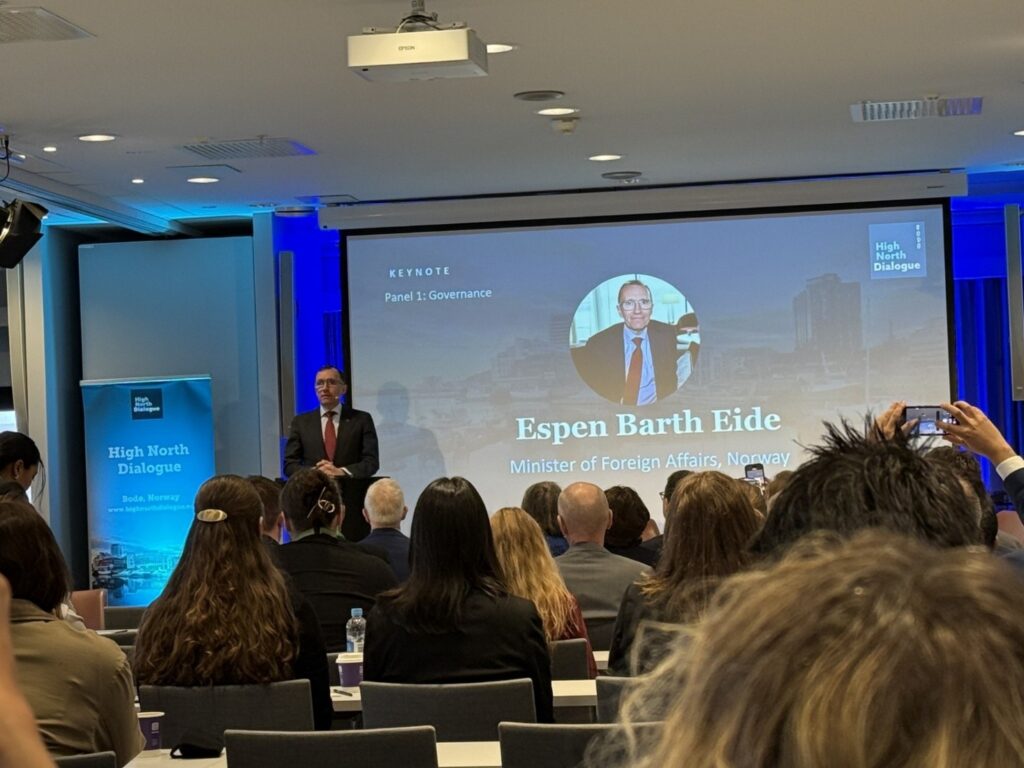
Experts, policymakers, researchers, and community representatives gathered at the High North Dialogue Conference in Bodø in April 2026. They explored how Arctic security, cross-border cooperation, and local resilience can be strengthened in an increasingly uncertain environment. Geopolitical tensions, vulnerable infrastructure, long distances, and harsh environmental conditions are reshaping preparedness needs across the Arctic.
Held for the tenth time, the conference focused on Arctic society, business, security, and resilience. Its 303 participants from 33 countries included researchers, practitioners, students, and residents of the Arctic region. The discussions under the theme “Our North, Our Future” were particularly relevant to Laurea’s ATOMEX project, which examines collaboration complexity in nuclear and radiological emergency preparedness in the maritime Arctic.
The Arctic’s security environment is changing
The Arctic region has been strategically important since the Cold War and remains a focal point for NATO countries, Russia, and increasingly China.
In 1960, an American U-2 reconnaissance aircraft was scheduled to land in Bodø after photographing Soviet missile sites. The aircraft was shot down over Soviet territory, contributing to one of the major crises of the Cold War.
The Kola Peninsula hosts one of the world’s most significant concentrations of Russian naval and nuclear assets, including submarine-based nuclear deterrent forces. The shortest flight paths for intercontinental ballistic missiles between North America and Russia pass over the Arctic, making Arctic surveillance and early-warning capabilities strategically important.
The NATO Joint Warfare Centre is headquartered in Stavanger.
Norway’s Minister of Foreign Affairs, Espen Barth Eide, noted that the aim has been “High North – Low Tension.” However, this is now challenged due to increasing uncertainty. The Cold War has not returned, but a Cold War–like situation may be emerging in the Arctic.
Geopolitical challenges have increased tensions and strategic interest in the Arctic region. Disruptions to oil and gas shipping through the Strait of Hormuz have had significant impacts on global energy markets and highlighted the vulnerability of major maritime energy routes, adding to broader interest in alternative energy sources and transport routes. At the same time, the September 2026 agreement between the United States, Denmark, and Greenland concerning military presence, facilities, and security cooperation in Greenland appears to have eased some of the recent tensions surrounding Greenland and Arctic security.
Although geographically remote, the Arctic is central to global geopolitics. The changing security environment also presents practical preparedness challenges: effective emergency response depends on stable international cooperation, functioning infrastructure, and coordination across national borders. These conditions are particularly important for nuclear and radiological emergencies, which may require several authorities and countries to cooperate under difficult Arctic conditions.
Resources and governance
In 2026, Norway alone accounted for supply of 12.8% of the EU’s oil and 30.6% of the EU’s natural gas (European Council, 2026a, 2026b), and these proportions have increased rapidly since Russia’s illegal invasion of Ukraine.
There is a common misconception that the Arctic is an ungoverned region whose resources are available to whichever actor claims them first. However, the United Nations Convention on the Law of the Sea (UNCLOS) provides a central legal framework for maritime rights, territorial waters, and rights to marine resources in the Arctic Ocean. While competing claims exist regarding parts of the continental shelf and maritime boundaries, most Arctic states have managed these issues through legal and diplomatic mechanisms.
The Arctic Council was established in the post–Cold War period for cooperation and dialogue. It consists of eight member states: Canada, Denmark, Finland, Iceland, Norway, Russia, Sweden, and the United States. Several non-Arctic countries have developed growing strategic or commercial interests in the Arctic. China, for example, explicitly identifies itself as a ‘near-Arctic state’ and promotes a Polar Silk Road, while countries such as the United Arab Emirates have shown increasing interest in Arctic shipping, logistics, investment, and cooperation. Strategic interests are related to defence, new, shorter logistical routes, natural resources, and minerals.
Naturally, it is crucial that all parties respect the international rules-based order to avoid larger conflicts in the Arctic region. At the same time, Arctic cooperation extends beyond relations between states and strategic interests. It also encompasses the rights, livelihoods, cultures, and cross-border relationships of the region’s Indigenous peoples.
Indigenous perspectives
Sápmi, the traditional homeland of the Sámi people, extends across Norway, Sweden, Finland, and Russia. After Russia’s invasion of Ukraine, cross-border cooperation and cultural connections involving Sámi communities in Russia have been significantly reduced or suspended, leading to a disruption in long-standing ties. One speaker noted that certain Sámi organizations and activists in Russia have been subject to official restrictions and security classifications, which has complicated cross-border cooperation.
Sámi people are facing the effects of global warming. Warming is fastest in the Arctic, and the changes are visible in the natural environment, weather conditions, and animal migration paths. In addition, increased resource extraction, wind energy development, and militarization in the reindeer herding regions create tensions and need for enhanced dialogue between national governments and Indigenous communities.
Preparedness depends on local and cross-border cooperation
Living in the High North presents its own challenges. The Mayor of Bodø, Odd Emil Ingebrigtsen, mentioned the landslide in August 2025 cutting the north-south railway connection (Forbes 2025). The case illustrated how local preparedness investments and decentralized maintenance capabilities can strengthen societal resilience during infrastructure disruptions. Because of preparedness efforts, Bodø has developed local workshops for train and logistics maintenance.
Cross-border collaboration between Nordic countries is already well established. For example, Norwegian rescue helicopters support emergency operations in Finnish Lapland. Authorities also depend on residents’ knowledge of the best routes available for rescue operations or military exercises.
Hans Kristian Madsen, Director of Fire and Rescue at Norwegian Directorate for Civil Protection (DSB), emphasized the need for both clear responsibilities for all related authorities and collaboration between them.
Ingibjörg Lilja Ómarsdóttir, Head of Disaster Recovery and Education, Civil Protection in Iceland, added that preparedness goes beyond the physical measures alone. For example, preparedness structures include coordination groups for psychosocial support. Resilience is frequently developed and discussed at both the societal and municipal levels. However, it is also crucial to ask: How can individuals strengthen resilience at the personal, family, and community levels?
Skolt Sámi fisherman Vesa Orassalo illustrated what resilience means in practice. “Picking up berries or fishing while surrounded by mosquitoes builds personal resilience. One must be prepared for water and heating outages and being able to treat minor injuries following accidents. Adaptability to changing and unexpected conditions is a key part of resilience,” said Orassalo.
Lessons for nuclear emergency preparedness
The conference discussions showed that preparedness in the Arctic cannot be treated solely as a technical or institutional matter. It depends on reliable infrastructure, clearly defined responsibilities, cross-border cooperation, local capabilities, and knowledge of the operating environment. The examples from Bodø, Nordic rescue cooperation, Icelandic civil protection, and Sámi communities all demonstrated that resilience is built through connections between authorities, communities, and individuals.
A radiological or nuclear incident in this environment could involve long distances, limited transport and communications infrastructure, severe weather, multiple jurisdictions, and communities with distinct local conditions and knowledge. Effective preparedness therefore requires more than formal emergency plans. It also requires trusted relationships, practical coordination arrangements, and an understanding of how national systems interact with local and cross-border capabilities.
The High North Dialogue provided ATOMEX with a broader societal context for this work. Its central lesson was that Arctic preparedness must connect technical expertise with institutional cooperation and community-level resilience. Strengthening these connections is essential for improving the region’s capacity to respond to complex emergencies.
About the ATOMEX project
ATOMEX (Collaboration Complexity in Nuclear Emergency Preparedness in the Maritime Arctic) is a project funded by the Research Council of Norway that aims to strengthen radiological and nuclear emergency preparedness as well as risk assessment capabilities in rescue operations in the Arctic maritime environment. One of Laurea’s responsibilities was to develop a serious learning game for the project. The learning game is based on the official guidelines, and it is designed to establish a shared level of knowledge among the participants before practical exercises. In addition to Laurea University of Applied Sciences, the ATOMEX project partners include Nord University, the Norwegian Radiation and Nuclear Safety Authority (DSA), and the Fraunhofer Center for Maritime Logistics and Services.
Main sources
- European Council 2026a. Where does the EU get its oil from? Accessed on 30.9.2026.
- European Council 2026b. Where does the EU’s gas come from? Accessed on 30.9.2026.
- Nikel, D. 2025. Travel Chaos After Landslide Splits Norway in Two. Forbes 30.8.2025.
- Nord University, Centre for Crisis Management and Collaboration – Nordlab.
- NRK. Distriktsnyheter Nordland. (23.4.2026). Accessed on 30.9.2026.
AI assistance was used to improve the readability of this article.