
This article presents the Steps Towards Employment (STE) model developed within the CeMeWE project to support migrant women in entering or re-entering working life and society. The model addresses the barriers like language, limited networks, non-recognition of qualifications, loss of professional identity, and uncertainty in navigating local labor markets. Developed through co-creation with migrant women…

Steps to employment as co-creation
Ensuring the social inclusion of migrant women remains a critical policy challenge across Europe, as structural barriers in employment, language acquisition, and access to services persist. For many migrant women, building a new life in another country means much more than relocation. It is a journey of rediscovering one’s voice and professional identity in a new context, which includes learning a new language, understanding unfamiliar cultural and professional norms, and starting a career from the beginning. It involves several dimensions simultaneously: social, economic, and psychological. Furthermore, migrant women face different kinds of challenges, such as navigating new cultural landscapes, and accessing essential services. Barries and issues specific for women include caring for their children (if they are mothers), gender-related cultural differences, as well as types of jobs available to women, such as service positions despite their strong competences (e.g., ENM Finland, 2022). The employment barriers include navigating unfamiliar job markets, non-recognition of foreign qualifications, and language difficulties, highlighting the importance of programs like peer mentoring and targeted support (Gower, Jeemi, Forbes, Kebble, & Dantas 2022; Ricci, Crivellaro, & Bolzani 2021; Ruiz & Donato, 2025; Theaker 2022).
The CeMeWE project (Central Baltic Mentoring for Migrant Women seeking Employment) was created specifically in response to the employment challenge of migrant women in the Central Baltic area. Funded by the Central Baltic Programme and running from April 2023 to May 2026 in Finland, Sweden, Estonia, and Latvia, it aims to create pathways to employment for migrant women through mentoring, collaborative learning, developing new skills and shared experiences. CeMeWE was coordinated by Laurea University of Applied Sciences (Finland) together with partner organizations such as local governments, think tanks and universities from across the region: Riga Technical University (Latvia), Institute of Baltic Studies (Estonia), Zemgale Planning Region (Latvia), and Region Uppsala (Sweden). CeMeWE developed, tested, and evaluated a model to support women in gaining employment-relevant skills and professional confidence, adding to the ongoing discussion of what integration means.
Project’s activities and building a model
CeMeWE worked with a process of co-creation, where women become active participants in designing their own path toward employment and inclusion. Through mentoring, dialogue, and shared practice, the project helped transform women’s professional potential into visible skill patterns and capacities. CeMeWE combined mentoring, training, peer support and networking into a framework designed to strengthen employability, professional and personal self-confidence, and the sense of belonging to society. More specifically, the project developed and tested a flexible mentoring model rooted in agency and partnership. It used tools, support, training materials, and programs that can be adapted across different countries, with the goal that the deliverables can be transferred to other contexts and be adjusted to the participants’ individual situation. CeMeWE collaborated with local communities and supported migrant women on their paths to employment. Ultimately, the project’s mission was to promote a mutual, cross-border model, jointly creating opportunities, and new connections.
To design this model, the project team analyzed a wide range of existing training, programs and mentoring tools and resources for migrant women across Estonia, Latvia, Sweden, and Finland. The team reviewed 24 practices, exploring their goals, methods, and results. Ultimately, four were chosen for further testing: Reinvent Yourself Spouse Program (Estonia), Auroras Mentoring (Finland), SMILE (Sweden), and Social Mentor Support for Ukrainian Refugees (Latvia). CeMeWE had practices such as informational support through success stories and information videos; social support through mentoring, peer support, and community interaction; as well as practical learning. The project identified three main target groups: women close to employment, those in need of reskilling, and those currently far from the labor market.
The analysis of existing practices across partner countries revealed that the most successful initiatives combine mentoring with active learning methods such as workshops, skills assessments, and networking sessions. Programmes such as SMILE (Sweden) and Social Mentor Support for Ukrainian Refugees (Latvia) demonstrated how structured mentoring can provide support to all women, those from furthest from the labor market and those who are very close to it. On the other hand, Reinvent Yourself Spouse Program (Estonia) and Auroras Mentoring (Finland) offered support for highly educated women ready to re-enter employment.
Based on the analysis of these existing practices, the project team developed the Steps Towards Employment (STE) model. The model has been created with project’s participants, adjusted by their stories, skills, and hopes through co-creation and co-design process, that is, it was built both with and for the women. That is, every iteration of the STE was shaped by women’s voices through workshops, evaluation, and their feedback. Hence, the model is grounded in the real needs of women in the participating countries and covers many themes, also addressing for example empowerment and health.
The development and implementation process was iterative and flexible. Each participant’s journey depends a lot on a woman’s individual situation, on where a woman stands today, her readiness, language level, professional background, and how close (or far) she is from the labor market. Hence, the model offers multi-layered support from light support and mentoring to intensive support and reskilling. This meant that the project was able to include women who were involved in all parts of the model, as well as those who participated in activities related to only one part of the model. The STE combines individual and group mentoring, micro-learning sessions, practical workshops, and blended online or offline activities.
The STE model contains six phases (Figure 1): Search (Pre-phase), Screen, Orient, Equip, Match, and Follow (Post-phase).
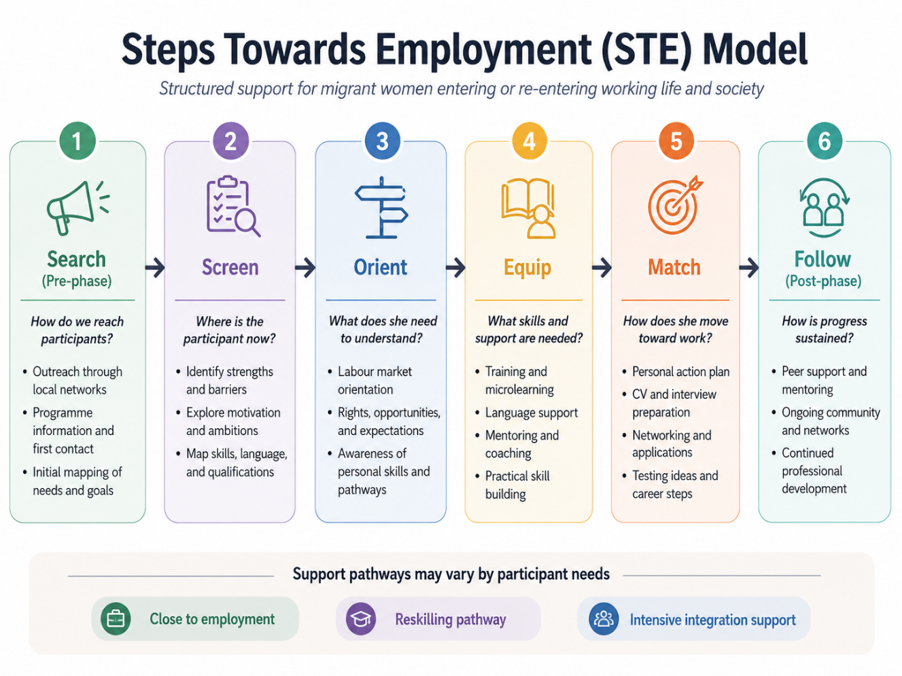
The pre-phase Search (Where can we find you?) consists of outreach, building trust and preparation. Information about the programme was disseminated through local networks and partner organizations, after which participants received the necessary guidance. The exact implementation of this stage depended on the type of organization involved. For example, some organizations do not typically work directly with participants in the target group and therefore need to invest more effort in identifying and reaching potential participants. In contrast, NGOs that work with relevant target groups on a daily basis often engage participants through their regular activities, making this phase less distinct in their context.
The Screening phase (Where are you now?) comprises discovering needs, where a woman’s strengths, barriers, and ambitions are identified in individual or group sessions. Language level, professional skills, recognition of prior qualifications, personal motivation and goals as well as individual, domestic, and societal barriers were outlined in various ways.
During the Orientation phase (What do you need to know?), participants explored how the labor market works, what employers expect, what rights and opportunities they have, and about different career opportunities. This phase helps building agency through awareness of their own skills and strengths. It helps understanding goals, barriers and what kind of knowledge and information the participant needs.
In the Equip phase (What do you need to have?), participants received targeted support, microlearning courses, or mentoring sessions and coaching. They build new skills and learn practical strategies to move closer to employment. Empowerment is important as well as addressing the CV, personal letter, interview training, etcetera. The phase can also contain language competence training.
In the Match phase (How will you get there?), mentors helped women shape an action plan, test ideas, and make job applications, prepare for interviews, or even start new projects. It is about preparing for the next step towards goals. Mentorship became a safe yet dynamic space for experimentation and skill growth.
Finally, the post-phase Follow (How can we enhance success?) helped participants stay connected through networks and communities, sharing experiences, supporting one another, and continuing their professional journeys. It is also about giving them service advice and contacts for the future, so they know where to turn for additional support. This ensures impact through continuous movement toward independence and inclusion.
Overview of the target group
The STE model recognizes the diversity of target group and tailors its approach to the identified needs of women. Within the CeMeWE project, three main target groups were identified, each representing a different starting point on the path toward employment and integration.
Group 1 were students or educated women motivated to find employment and ready to apply their skills in a new context. Their main challenge was not a lack of competence, but a lack of orientation, that is, understanding how to navigate the local labor market, where to search for opportunities, how to write a CV that fits local standards, and how to build useful connections.This group also included women who have already found a job in their destination country, but one that does not match their previous experience or education. For example, teachers or engineers who worked in the service sector or have very light workloads, which did not satisfy them. Typical examples of this target group included IT specialists, economists, accountants, technicians, and service professionals such as cooks, hairdressers, or massage therapists.
Group 2 were women who could not use their previous education/profession. Many group representatives worked in low-skilled jobs, often rather below their level of previous education and capacity. For some women, this meant short qualification courses, whereas for others it could be one to three years in vocational or professional schools, as required by national regulations. Women in this group sought a career change and were ready for a new path. The group had, for instance, a chemical engineer who aspired to work in tech and be UI/UX designer etc. The reskilling courses provided by the project were service design, textile analysing, and digital education.
Group 3 faced wider and deeper barriers in both individual, societal and domestic areas. These were women who often had limited education or literacy, and emotional or psychological burdens or other health issues. Many of them struggled not only with language and bureaucracy, but with loss, trauma, and a sense of disconnection from the new society around them. Common needs were recovery and emotional stability, feeling of safety and connection with the new society. Ukrainian refugees were a special group in this project, which went through forced immigration where the first need was to sort out the experiences, emotions and make decisions regarding the qualification, requalification and integration to the labor market. The project also included refugees from other parts of the world, of which many needed intense support in many areas. For many such women, small community activities, peer support groups or supportive mentoring became valuable ways toward confidence and belonging. Thereafter, or in parallel, one could address personal development and orientation towards work or studies. Many came from cultural contexts very different from the Nordic and European environment. Language barriers were high; some spoke only their native language. Education levels varied, but some had never completed formal schooling.
To conclude, the professionals working with the different target groups of unemployed women need different sets of tools for different women. Needs are individual, and this means a holistic manner, working in parallel both with directly job-related themes and themes belonging to confidence, empowerment, health, and so on, is a key factor. This adjustable, listening and flexible approach creates more tailored support for each woman. A more thorough description of the model and its implementation in the different countries is described in Leminen and colleagues (under preparation).
This document has been produced with the financial support of the European Union under the Interreg Central Baltic Programme 2021-2027, within the project “Central Baltic Mentoring for Migrant Women seeking Employment” (CeMeWE). Its contents are the sole responsibility of Laurea University of Applied Sciences and do not necessarily reflect the views of the European Union.
Generative AI was used in creating the abstract.
References
- Gower, S., Jeemi, Z., Forbes, D., Kebble, P., & Dantas, J. A. R. 2022. Peer Mentoring Programs for Culturally and Linguistically Diverse Refugee and Migrant Women: An Integrative Review. International Journal of Environmental Research and Public Health 19, 12845.
- Ricci, A., Crivellaro, F., & Bolzani, D. 2021. Perceived Employability of Highly Skilled Migrant Women in STEM: Insights from Labor Market Intermediaries’ Professionals. Administrative Sciences 11, 7.
- Ruiz, M., & Donato, S. 2025. Women migrant workers’ (WMWS) deskilling. Open Research Europe 4, 186.
- Theaker, A. 2022. Enabling Women Entrepreneurs in a Rural Context through Mentoring. Academy of Management Proceedings.