
While the national agenda about internationalisation and the role of higher education institutions remains important in Finland, staff are constantly finding ways to support and guide international students. In this piece, I argue that a welcoming and supportive attitude can go a long way.
The effect of a friendly atmosphere
For full disclosure, I am an international in Finland, and therefore this is a matter that is close to my heart. Few weeks ago, I participated in Laurea’s first ever official welcoming event for international students. The event was well received by the participating international students, and it gave opportunities to talk to them about formal and informal matters. The event was organised by the Student Affairs department in collaboration with Wellbeing services. Various activities engaging students and staff facilitated ice-breaking that later was useful because we had time to start and continue conversations. The fact that this was the first time such event was organised at Laurea was important. Amongst the few participating staff, we discussed and understood the relevance of this type of event as well as the importance of our presence.
International students felt noticed and acknowledged, were eager to talk, to know about different opportunities for their own development and for getting to know and interact with Finnish students. International students go through a process not only of decision making, selection of country where to study and higher education institution, but complex migratory and emotional processes to get here (i.e. see the Maahanmuuttovirasto 2026 for an insight on the requirements they must comply with). Therefore, it is not a simple decision nor fact that they have chosen us and that they are here with us. My question here is, how do we contribute to their student experience at Laurea? One possible initial answer is by making them feel welcome with our attitude towards them.
Nonetheless, in my view, our job does not necessarily end there. We continue meeting students throughout their journey at Laurea, and thus, according to our relationship with them, we are responsible for supporting or guiding them. By support I mean answering a question if we know the answer or help finding the answer; and by guidance, I mean, to refer them to the right channel of support. My words may sound a bit strong, and perhaps they are, but much has been researched already, written about in the national news, discussed in formal meetings and over coffee tables about how to support our international students and on how we, in Finland, are doing about that. This shows that people are interested, but maybe, in our everyday work practice, staff are unsure about how or where to start.
Staff and students are active agents
Based on my experience at Laurea, we can start from any point where we encounter an international student depending on our role. We could also be more aware that we have an advantage about knowing how things work here at our university and in Finland, and they are learning about all of that. We could support or guide, for example, when international students first arrive to campus, or if we meet them through teaching at any point of their student journey, or as dissertation supervisor or as commissioner through RDI and course collaboration. Having said that, I do not intend to position international students in any place of simple vulnerability. On the contrary, my purpose is to highlight our role for contributing to their wellbeing and integration process. That means that we can be active agents in their student journey, and not only witnesses.
By the fact that they have come to Finland to study and pursue their goals, they are active agents. Furthermore, it could also be relevant to gain insights from what students go through in their own voice. For instance, in a blog published by Aalto University, one student reported about different experiences in their everyday life, i.e. money was a matter and the weather too (Vitória 2025). In another publication from the University of Oulu, a student opens up about positive and negative experiences during their first year in Finland (Athina n.d.). Upheavals of emotions are part of the process of adaptation to a new environment, which is understood as cultural shock (Winkelman 1994).
Moreover, in a blog from the University of Turku a student analyses cultural differences relevant to many of them (Sanabria 2025). My last example comes from a publication done by international students who interviewed others alike, where they give tips on how to get by and flourish in Finland (Tegin 2025). These examples from recent publications demonstrate that international students, when given the opportunity to reflect on their experiences in Finland, are willing to share them and offer, in that manner, additional guidance to others in a similar position as them. On top of that, they write from a positive viewpoint despite the challenges that they may have faced.
Closing remarks
It may be also important to highlight that while Finnish higher education institutions have been receiving international students and staff for a long time, the current trends are unprecedented. Narrowing down again to our practice at Laurea, we could also see this as both staff and students are in a meeting place where we are learning about the best ways to share the same place, be productive, and achieve our targets and goals.
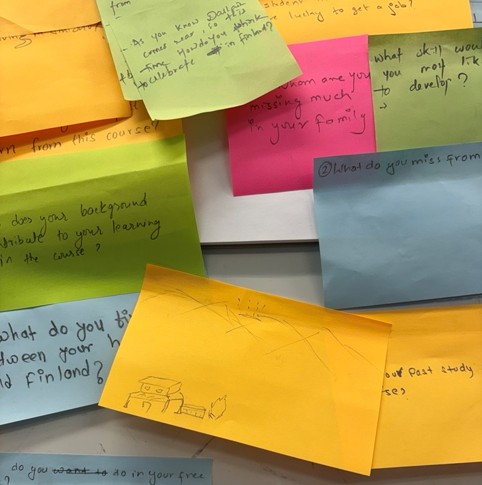
Finally, I chose the image for this article from an activity that we did today on our first day of teaching a new group of international students. My colleague and I ran an exercise through which we all wrote three questions about things we wanted to ask to each other. The objective was to get to know the group. Many questions were about skills and competences they wanted to acquire on the course, while many others were on feelings about being here and what they missed from their home country. The drawing from one of students tells more than any words could. That reminded me that in principle, we are all humans with our own stories meeting here.
Lähteet
- Athina n.d. Emotional experiences of a first-year international student. UniOulu Ambassador Blog.
- Maahanmuuttovirasto 2026. Studying in Finland.
- Sanabria, R. 2025. Beyond deadlines and grades: 5 lessons about studying in Finland. Student Life at the University of Turku.
- Tegin, M. 2025. Coping with student life in Finland: tips from foreigners. Satakieli.
- Vitória 2025. Small Struggles of an International Student Moving to Finland for the First Time. Our blogs A?
- Winkelman, M. 1994. Cultural Shock and Adaptation. Journal of Counseling & Development, 73: 121-126.